What Lionel Messi Eats in a Day: Reported Diet, Calories, and Macros
Lionel Messi's exact daily meal plan is not public, but his reported diet is clear enough to build a realistic Messi-inspired training day with calories, macros, and context around each meal.
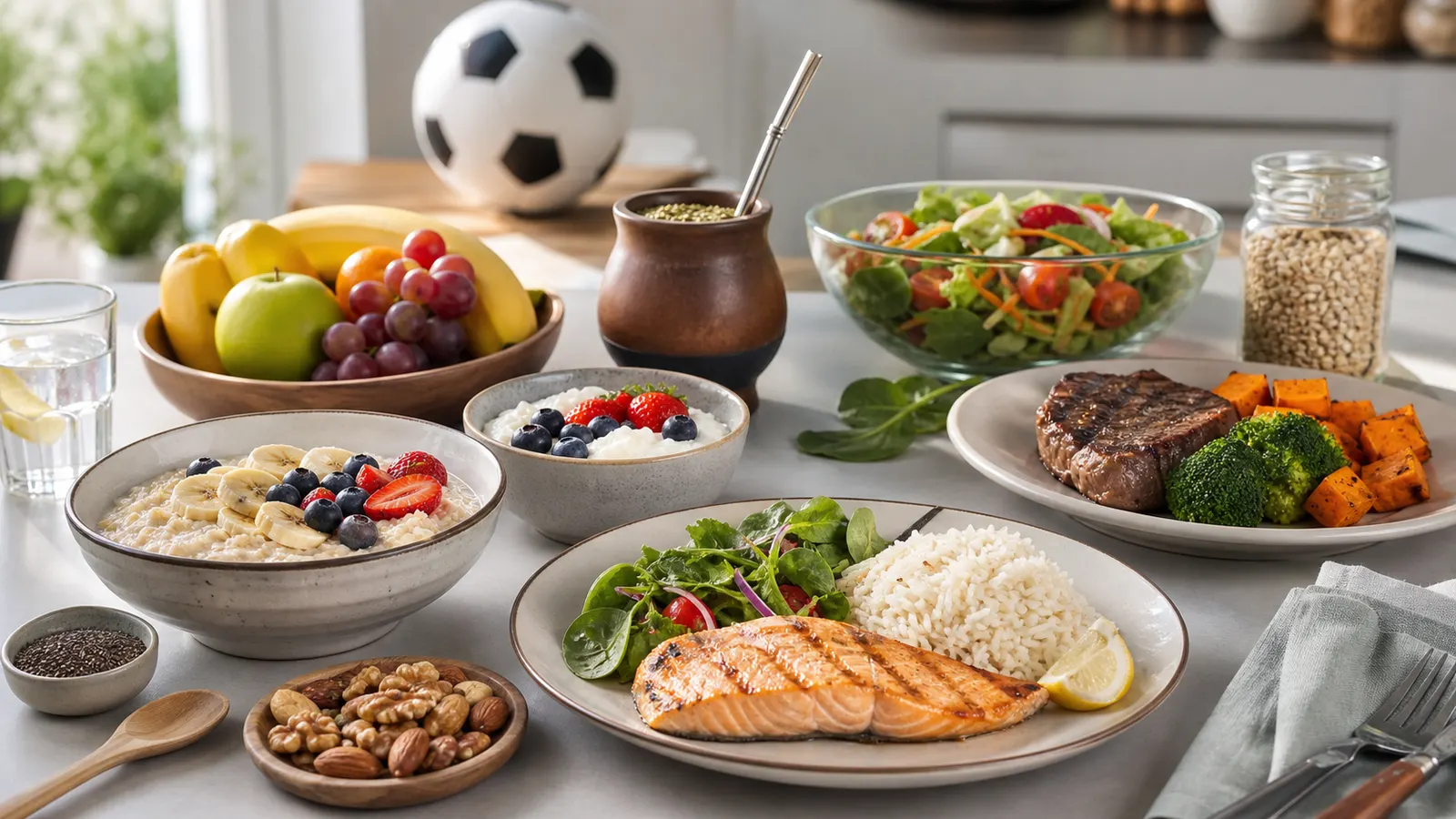
TL;DR. Lionel Messi's exact private meal plan is not public. What is public is the pattern: Messi has said he moved away from chocolate, alfajores, soda, and chaotic eating, and now eats in a more ordered way with fish, meat, salad, and vegetables1. His nutrition adviser Giuliano Poser has been reported as emphasizing minimally processed foods: extra virgin olive oil, unrefined grains, seasonal fruits and vegetables, unroasted nuts, eggs, and fresh fish2. A realistic Messi-inspired training day lands around 2,800 to 3,200 calories, with roughly 130 to 160g protein, 350 to 450g carbs, and 75 to 95g fat, depending on training load, match schedule, and portions.
Quick answer: reported foods include fish, meat, salad, and vegetables; older habits included chocolate, alfajores, and soda. Poser's reported emphasis is minimally processed food: fruit, vegetables, unrefined grains, unroasted nuts, olive oil, eggs, and fish. A practical Messi-inspired day could look like oats, fruit, and egg at breakfast; fruit, nuts, and mate as a snack; fish, rice, salad, and olive oil at lunch; yogurt and berries in the afternoon; then meat or fish, potato, vegetables, and salad at dinner.
There are two bad ways to write about Messi's diet.
One is to pretend we know his exact breakfast, snack, lunch, dinner, and bedtime routine. We do not. Athletes of Messi's level have private staff, travel schedules, matches, recovery days, sponsors, family meals, and menus that change.
The other bad version is to flatten the story into "Messi eats clean." That is not very useful either. The interesting part is the structure: enough carbohydrate to train and play soccer, enough protein to recover, enough fat to keep meals satisfying, and fewer sugary or ultra-processed foods that can make energy, digestion, and body composition harder to manage.
So this article does two things. First, it separates what has actually been reported about Messi's eating. Then it turns that information into a practical meal-by-meal training day with estimated calories and macros.
A note before reading. This article is general nutrition education, not medical advice or a claim to know Messi's private diet. Nutrition values are rounded estimates from USDA FoodData Central and common label values, so exact numbers will vary by brand, cooking method, portion size, and food preparation3. If you have a medical condition, a history of disordered eating, or a sport-specific performance goal, work with a qualified clinician or registered dietitian.
What reliable sources actually say
Messi's reported diet is more specific than most celebrity diet rumors, but still not specific enough to call any menu "his exact day."
Messi says the big change was order. In a 2018 AS article, Messi described eating poorly in his early 20s, naming chocolate, alfajores, and soda as part of his old pattern. He said his current eating is more ordered and includes fish, meat, salad, and vegetables1.
Giuliano Poser's reported food list is simple. AS, citing EFE and Poser's comments to Corriere della Sera, reported that he recommended organic foods, a variety of unrefined grains, seasonal fruit and vegetables, unroasted nuts, extra virgin olive oil, eggs, and fresh fish. Poser also emphasized that food should be treated as little as possible and that breakfast matters2.
The sweets-and-refined-foods theme shows up repeatedly. The practical takeaway is not that sugar is poisonous. It is that an elite footballer who needs repeat sprint ability, digestion comfort, lean mass, and recovery would be unlikely to benefit from building most days around soda, sweets, and refined snacks.
Yerba mate belongs in the cultural picture. AP describes yerba mate as ubiquitous in several South American countries and notes Messi among the famous players associated with the drink4. Unsweetened mate is not a calorie source. It is more like coffee in the meal plan: cultural, caffeinated, social, and basically calorie-free unless sweetened.
Milanesa belongs in the comfort-food picture. Because Messi's food story is also an Argentine food story, milanesa, the Argentine breaded cutlet, is useful context. That does not make it a daily training staple. It means his diet still has a human side: comfort foods can fit, but a fried breaded cutlet with cheese, sauce, or fries is a different macro event than grilled fish with rice and salad.
The honest conclusion: Messi's public diet pattern is whole-food, carb-supported, protein-aware, and less sugary than his earlier habits. The exact menu changes. The principles are consistent.
The evidence boundary matters: the strongest direct source is Messi's own 2018 comment. The Poser details are reported through media coverage, not a published daily meal plan.
A plausible calorie range
Inter Miami lists Messi at 5'7" and 148 lb5. That is about 67 kg. No reliable source publishes his daily calorie target. For a player with that body size, a hard training or match day can plausibly require far more food than a normal sedentary day, but exact needs depend on minutes played, training load, travel, temperature, body-composition goals, and recovery status.
For a Messi-inspired estimate, use a range instead of one fake-precise number:
| Day type | Estimated calories | Why |
|---|---|---|
| Rest or light recovery day | 2,300-2,700 | Lower training demand, less need for extra starches |
| Normal training day | 2,700-3,200 | Field work, gym/prehab, recovery, daily movement |
| Match day or heavy double-session day | 3,200-3,800+ | More carbohydrate before and after play, higher total energy demand |
The meal plan below sits around 2,840 calories, 141g protein, 389g carbs, and 81g fat. For Messi's listed body weight, that is roughly 2.1g protein/kg and 5.8g carbs/kg. The protein number is slightly above the broad ISSN range of 1.4-2.0g/kg/day for most exercising individuals, and ISSN recommends distributing protein across the day6. The carbohydrate number fits a soccer-style training day: the Academy of Nutrition and Dietetics, Dietitians of Canada, and the American College of Sports Medicine position stand gives 5-7g/kg/day for moderate training and 6-10g/kg/day for 1-3 hours of moderate-to-high-intensity exercise7.
For a regular person reading this: do not copy the calories unless your body size and activity level justify them. Copy the structure first.
The Messi-inspired day at a glance
This is not a leaked Messi menu. It is a realistic training-day template built from the foods he has publicly discussed, the foods his nutrition adviser has reportedly emphasized, and practical athlete-food substitutions.
These numbers use one representative version of each meal. Swapping salmon for lean beef, rice for pasta, or different yogurt and granola brands can shift the totals.
| Meal | Foods | Calories | Protein | Carbs | Fat |
|---|---|---|---|---|---|
| Breakfast | Oats, milk, banana, berries, egg | 610 | 24g | 95g | 15g |
| Snack 1 | Fruit, nuts and seeds, mate or water | 300 | 7g | 32g | 17g |
| Lunch | Fresh fish, rice or pasta, salad, vegetables, olive oil, fruit | 730 | 38g | 105g | 18g |
| Snack 2 | Greek yogurt, berries, granola, honey | 280 | 20g | 45g | 2g |
| Dinner | Lean beef or salmon, sweet potato, vegetables, salad, olive oil, bread | 750 | 40g | 95g | 22g |
| Supper | Cottage cheese or yogurt, kiwi, walnuts | 170 | 12g | 17g | 7g |
| Total | 2,840 | 141g | 389g | 81g |
The important pattern is not the exact gram count. It is that every meal has a job:
- Breakfast starts the day with carbs, fluid, and some protein.
- Snacks add energy without turning into sweets and soda.
- Lunch and dinner anchor protein, starch, vegetables, and olive oil.
- Supper is optional and mainly supports recovery.
Now, meal by meal.
Breakfast: oats, fruit, eggs, and hydration
Example meal
- 70g rolled oats cooked with 1 cup low-fat milk
- 1 banana
- 1/2 cup berries
- 1 whole egg
- Water, coffee, or unsweetened mate
Estimated macros: ~610 calories, 24g protein, 95g carbs, 15g fat
Breakfast is where Poser's reported advice is clearest: he emphasized minimally processed foods and said breakfasts are fundamental2. For a footballer, that makes sense. Morning food does not need to be complicated, but it should not be only coffee and a pastry if the day includes training.
Oats and banana provide carbohydrate for training. Milk and egg add protein and micronutrients. Berries add fiber and polyphenols without much calorie load. The meal is high-carb on purpose, because soccer is not powered by dietary fat alone. Repeated sprints, cuts, accelerations, and ball work depend heavily on stored carbohydrate.
For a normal reader trying to lose weight, this breakfast can be scaled down easily: use 40-50g oats, keep the fruit, and decide whether you need the egg based on your protein target. For an athlete training hard, the larger bowl makes more sense.
Snack 1: fruit, nuts, seeds, and mate
Example meal
- 1 apple, orange, or banana
- 1 oz mixed nuts or walnuts
- 1 teaspoon chia seeds or pumpkin seeds
- Unsweetened yerba mate or water
Estimated macros: ~300 calories, 7g protein, 32g carbs, 17g fat
This is the simplest way to interpret Poser's reported food list: fruit, nuts, and seeds, paired with an unsweetened drink. It is also where Messi's Argentine context naturally appears. Yerba mate is culturally important across Argentina and other South American countries, and AP notes that Messi is among the famous footballers associated with it4.
From a macro perspective, mate itself does not do much unless it is sweetened. The food is doing the work: fruit gives quick carbohydrate, nuts and seeds add fat, minerals, and satiety. This snack is not high protein, and that is fine. Not every meal has to solve every macro.
The easy mistake is turning "nuts are healthy" into a 600-calorie handful. Measure once or twice so you know what 1 oz actually looks like. For more lower-calorie snack ideas, see our guide to healthy snacks under 200 calories.
Lunch: fish, rice or pasta, salad, vegetables, and olive oil
Example meal
- 4 oz fresh white fish or other lean fish
- 1.5 cups cooked rice, pasta, or another whole grain
- Large salad with tomatoes, greens, carrots, cucumber, and herbs
- 1 cup cooked vegetables
- 1 tablespoon extra virgin olive oil
- 1 piece of fruit
Estimated macros: ~730 calories, 38g protein, 105g carbs, 18g fat
This lunch is basically the reported Messi pattern in one plate: fish, salad, vegetables, whole grains, fruit, and olive oil.
The fish provides high-quality protein without making the meal too heavy. The rice or pasta supplies carbohydrate, which matters because a soccer player's lunch often has to support either training later in the day or recovery from a morning session. The salad and vegetables add volume, fiber, potassium, magnesium, and color. Olive oil raises the meal's calorie density and brings the Mediterranean-style fat source that Poser reportedly emphasized2.
If you are trying to make this more "Messi-like," do not obsess over whether the grain is rice, pasta, oats, quinoa, or bread. The bigger principle is that the carb source is planned, the protein is clear, the vegetables are present, and the added fat is deliberate.
For weight loss, reduce the starch to 3/4 to 1 cup and keep the fish and vegetables. For a hard training day, increase the starch or add bread.
Snack 2: yogurt, berries, granola, and honey
Example meal
- 3/4 cup plain Greek yogurt
- 1 cup berries
- Small handful of granola
- 1 teaspoon honey
Estimated macros: ~280 calories, 20g protein, 45g carbs, 2g fat
This snack is not specifically reported as a Messi staple. It is included because it fits the pattern: minimally processed, easy to digest, carb-plus-protein, and practical between training, meetings, family time, or travel.
Plain Greek yogurt adds protein without much fat. Berries and granola add carbohydrate. Honey is optional, but a small amount can make the snack easier to eat without turning it into dessert. This is also the kind of snack that helps distribute protein across the day, which lines up with sports nutrition guidance to spread protein feedings rather than saving most protein for dinner6.
For a lower-calorie version, skip the granola. For a higher-carbohydrate training snack, add a banana or a larger cereal portion.
Dinner: meat or salmon, sweet potato, vegetables, salad, and bread
Example meal
- 4 oz lean beef, chicken, or salmon
- 1 large sweet potato or regular potato
- 1 cup vegetables
- Salad with vinegar, herbs, and 2 teaspoons olive oil
- 1 slice whole-grain bread
Estimated macros: ~750 calories, 40g protein, 95g carbs, 22g fat
Messi has publicly mentioned fish, meat, salad, and vegetables as part of the way he eats now1. Dinner is where that becomes flexible.
Lean beef fits the Argentine food context often associated with Messi. Salmon or fresh fish fits Poser's reported emphasis. Chicken works if you want a lighter option. The sweet potato or potato keeps the meal performance-oriented instead of turning dinner into protein and salad only. That matters because under-fueling carbohydrate after hard training can make the next session feel worse.
The bread is optional. On a heavy day, it is useful. On a rest day, you may not need it. The olive oil is also deliberate: it makes vegetables more satisfying and adds calories without requiring a huge volume of food.
This is the meal where people often overcorrect. They hear that Messi cut down on soda and sweets, then assume the answer is very low carb. That is not the lesson. The lesson is better carbs, better timing, and fewer low-value extras.
Supper: optional recovery snack
Example meal
- 1/2 cup cottage cheese or plain yogurt
- 1 kiwi or other fruit
- Small sprinkle of walnuts
Estimated macros: ~170 calories, 12g protein, 17g carbs, 7g fat
There is no reliable public source saying Messi eats a nightly "supper" like this. Treat it as an optional athlete-style recovery snack, not a Messi fact.
The reason it belongs in the structure is simple: some athletes do better with a small protein feeding before bed, especially if dinner was early or training was late. ISSN notes that pre-sleep casein protein can increase overnight muscle protein synthesis, though their cited dose is higher than this small snack6. Cottage cheese and Greek yogurt are practical casein-rich foods.
For most people, supper is optional. If you are genuinely hungry, it can prevent late-night grazing. If you are not hungry and your protein target is already handled, skip it.
Where milanesa fits
Milanesa is an Argentine breaded cutlet, usually beef or chicken, and it can be served simply with salad or turned into a much heavier plate with cheese, sauce, ham, fries, or a sandwich roll. It is useful here because it shows the difference between Argentine comfort-food context and a lighter daily training pattern.
From a macro point of view, milanesa is not "bad." It is just easy to underestimate.
| Version | Estimated calories | Why it changes |
|---|---|---|
| Baked chicken milanesa with salad | 450-650 | Lean protein, breadcrumbs, less oil |
| Fried beef milanesa with potatoes | 700-1,000 | Oil absorption plus a starchy side |
| Milanesa napolitana with fries | 1,000-1,400+ | Cheese, sauce, ham, frying oil, fries |
That is why milanesa makes more sense as comfort food or a planned higher-calorie meal than as the backbone of a daily athlete diet. A professional player can fit it. A regular person can fit it too. The question is whether it fits the day around it.
If you wanted a more performance-friendly version, you would bake or air-fry the cutlet, use chicken or lean beef, add a big salad, and choose potato, rice, or bread rather than stacking all three.
What Messi has said he reduced
Based on his own comments and Poser's reported advice, the supported limits are fairly narrow:
- Soda and sugary drinks, based on Messi's own mention of soda
- Frequent chocolate and alfajores, based on Messi's own comments
- A daily pattern built around refined grains, based on Poser's emphasis on unrefined grains
- A chaotic, unstructured pattern, based on Messi's own contrast between eating badly before and eating "ordered" now
This does not mean Messi never eats dessert, bread, wine, or favorite foods. In the same AS piece, he said he eats everything but in an ordered way and occasionally has wine1. That is a better lesson than purity. The diet got more structured, not joyless.
How to adjust the Messi-inspired day
For a match day
Raise carbs and reduce digestive risk.
- Add an extra cup of cooked rice or pasta at lunch or dinner.
- Add a banana, toast, or a sports drink closer to the match if tolerated.
- Keep fats and fiber moderate in the last few hours before playing.
- Prioritize post-match carbs, protein, and fluids.
For a rest day
Keep protein and produce steady, then reduce starches.
- Use 40-50g oats instead of 70g.
- Use 3/4 cup rice or pasta at lunch instead of 1.5 cups.
- Skip the bread at dinner.
- Keep vegetables, fruit, fish, eggs, yogurt, and olive oil.
For fat loss
Do not copy an elite player's calories. Copy the plate structure.
- Protein at meals
- Fruit instead of sweets most of the time
- Planned starch portions
- Vegetables at lunch and dinner
- Measured oils, nuts, and fried foods
If you need help setting numbers, start with the calorie and macro calculator, then use our guide to tracking macros to understand what the numbers mean.
For soccer training
Pair this with the right training structure. The diet supports the work; it does not replace it. For field sessions, speed work, and recovery planning, see our Lionel Messi workout routine.
Frequently asked questions
What does Lionel Messi eat for breakfast?
His exact breakfast is not public. Giuliano Poser's reported advice emphasizes minimally processed foods and says breakfast is fundamental2. A realistic Messi-inspired breakfast would be oats or another whole grain, fruit, eggs or yogurt, and water or mate.
How many calories does Messi eat per day?
No reliable source publishes Messi's exact daily calorie intake. Based on his listed size and elite soccer workload, a plausible range is roughly 2,700-3,800+ calories depending on whether it is a rest day, training day, or match day. The sample day in this article is about 2,840 calories.
What are Messi's macros?
His exact macros are not public. The sample training day here lands around 141g protein, 389g carbs, and 81g fat. That is a high-carb, moderate-to-high-protein athlete template, not a universal prescription.
Does Messi eat meat?
Yes. Messi has publicly said he now eats fish, meat, salad, and vegetables in a more ordered way1.
Does Messi eat sugar?
Messi has said chocolate, alfajores, and soda were part of his old eating pattern, and Poser's reported advice emphasized minimally processed foods and unrefined grains12. That does not mean zero sugar forever. It means those foods are better understood as foods he reduced, not the base of the daily pattern he described.
Does Messi drink yerba mate?
Yerba mate is strongly associated with Argentina's soccer culture, and AP notes Messi among famous footballers associated with the drink4. Unsweetened mate has minimal calories, but sweetened or bottled versions can add sugar.
Is milanesa part of Messi's diet?
Milanesa can fit, but it is not the same as the lighter daily pattern reported by Messi and Poser. Treat it as a planned meal, not evidence of his daily training diet.
Where Mindful fits
The useful lesson from Messi's diet is not celebrity imitation. It is food awareness.
You do not need a private chef to notice whether breakfast is mostly sugar, whether snacks are unplanned, whether protein is uneven, whether carbs support training, or whether oils and fried foods are quietly changing your calorie total. That is exactly where tracking helps.
Mindful lets you log meals and see calories, protein, carbs, and fat together, so you can build your own version of the structure: enough food for the life you actually live, fewer automatic snacks, and meals that support your goals instead of fighting them.
References
Footnotes
-
AS. "La alimentacion de Messi para evitar sus episodios de vomitos." March 2018. Messi discusses his earlier intake of chocolate, alfajores, and soda, and says his current eating includes fish, meat, salad, and vegetables in a more ordered way. Source ↩ ↩2 ↩3 ↩4 ↩5 ↩6
-
AS / EFE. "Guiliano Poser, medico italiano de Messi: 'No soy un brujo'." April 2017. Poser describes recommending minimally processed foods, unrefined grains, seasonal fruits and vegetables, unroasted nuts, extra virgin olive oil, eggs, fresh fish, and fundamental breakfasts. Source ↩ ↩2 ↩3 ↩4 ↩5 ↩6
-
USDA. FoodData Central. Nutrition database used as a baseline for rounded food estimates. Source ↩
-
Associated Press. "A taste of home, yerba mate is a shared bond for many World Cup fans." June 16, 2026. AP describes yerba mate's South American soccer context and notes Messi among famous drinkers. Source ↩ ↩2 ↩3
-
Inter Miami CF. "Leo Messi." Official player profile listing Messi at 5'7" and 148 lb. Source ↩
-
Jager R, Kerksick CM, Campbell BI, et al. "International Society of Sports Nutrition Position Stand: protein and exercise." Journal of the International Society of Sports Nutrition 14:20. June 2017. DOI ↩ ↩2 ↩3
-
Thomas DT, Erdman KA, Burke LM. "Nutrition and Athletic Performance." Medicine & Science in Sports & Exercise 48(3):543-568. March 2016. Position stand from the Academy of Nutrition and Dietetics, Dietitians of Canada, and the American College of Sports Medicine. DOI ↩