Protein Calculator: How Much Protein Do You Need Per Day?
Calculate your daily protein target based on weight, activity level, and goals. A research-backed protein calculator that explains how much protein you actually need.
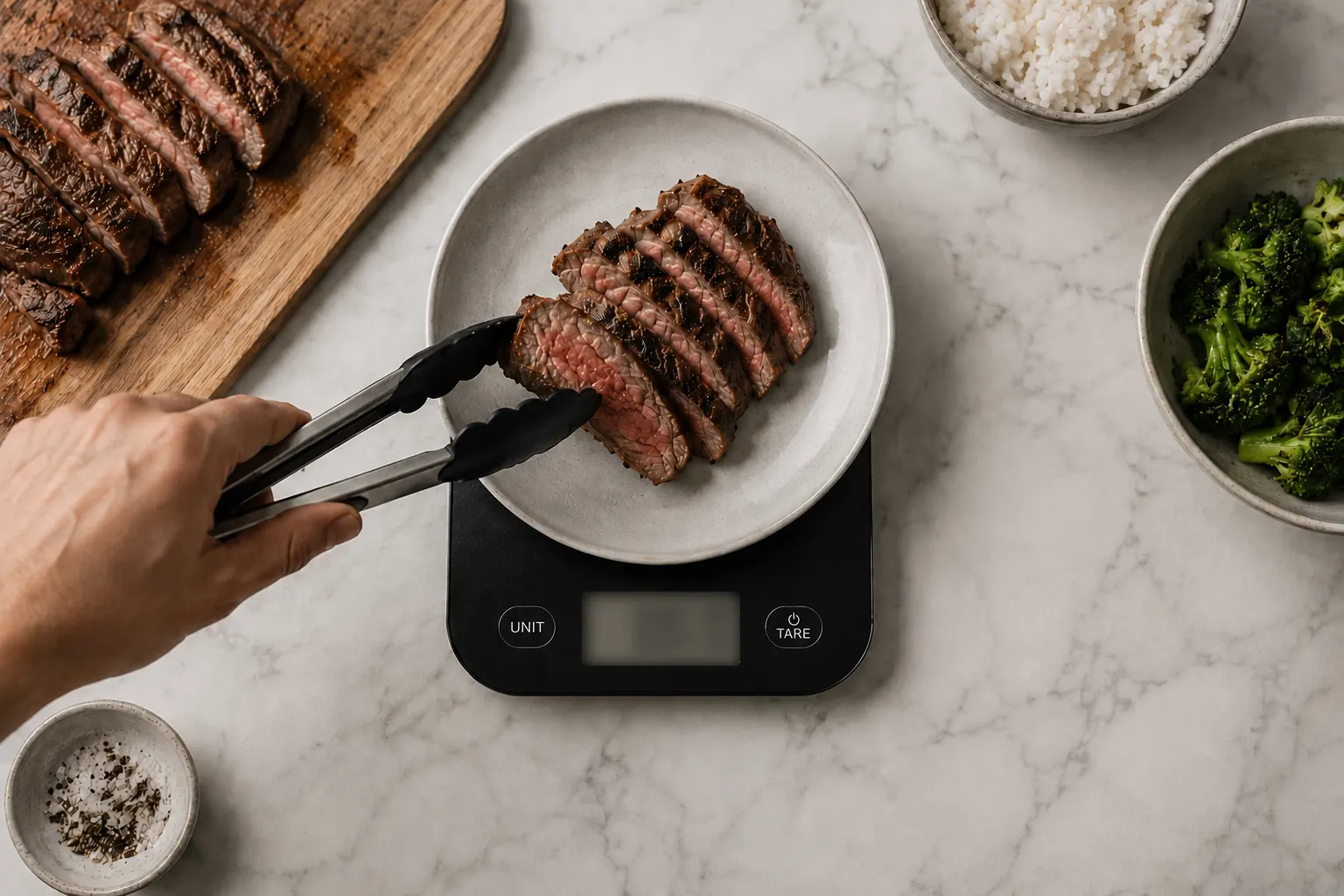
TL;DR. Most active adults need somewhere between 1.2 and 2.2 grams of protein per kilogram of body weight per day, which is about 0.54 to 1.0 grams per pound, depending on activity level and goals. The RDA of 0.8 g/kg, or about 0.36 g/lb, is a deficiency-prevention floor for sedentary adults, not an optimal target for most people who train, are losing weight, or are over 65. The most-cited threshold in the strength-training research is 1.6 g/kg/day (about 0.73 g/lb), which a 2018 meta-analysis of 49 randomized trials identified as the point above which additional protein produced no further gains in lean mass. People preserving muscle during a calorie deficit benefit from going higher, typically 1.8 to 2.2 g/kg (about 0.82 to 1.0 g/lb). The calculator below estimates your target. The rest of this article explains how the number is set, when to push above the standard threshold, and how to actually hit it.
Most adults dramatically underestimate how much protein they need. The official RDA from the Institute of Medicine is 0.8 g/kg of body weight per day, and that figure has anchored most public nutrition guidance for decades. It is technically correct as a minimum to prevent deficiency in sedentary adults. It is not what the research recommends for people who are training, losing weight while wanting to preserve muscle, building lean mass, aging, or simply trying to feel full and stable through the day.
This article walks through what the evidence actually says, when to use a higher target, and how to set a number that matches your situation.
Protein calculator
Interactive calculator
Estimate your daily protein target
Choose your goal and body weight to estimate a research-grounded daily protein range and a simple per-meal target.
Use this as a starting target. If you have kidney disease, are pregnant or nursing, or have a medical condition affecting protein needs, set your target with a clinician.
A note before reading. Protein targets are useful for healthy adults whose bodies handle typical protein intakes well. If you have kidney disease, are pregnant or nursing, are managing a specific medical condition, or have a current or past eating disorder, work with a registered dietitian or physician for personalized guidance instead of using a self-directed calculator.
Why the RDA is a floor, not a target
The Institute of Medicine's Recommended Dietary Allowance for protein, set in the 2005 Dietary Reference Intakes report, is 0.8 g/kg of body weight per day, or about 0.36 g/lb, for adults aged 19 and older1. This is the figure that anchors the "Daily Value" of 50 g shown on Nutrition Facts labels.
The RDA is correct as a deficiency-prevention threshold. It is also widely acknowledged in the sports nutrition, aging research, and weight-management literatures as too low to be useful as an optimal target for many people. Three reasons stand out.
It was set in sedentary adults. Nitrogen-balance methodology, the technique used to derive the RDA, captures what is required to maintain stable lean tissue at rest in inactive adults. People who train, particularly with resistance, have measurably higher protein needs because their bodies are constantly remodeling muscle tissue.
It does not account for fat loss. When you eat in a calorie deficit, your body draws on both fat and lean tissue for energy. How much it takes from each is heavily influenced by how much protein you eat. The RDA does not address this scenario.
It does not account for aging. Older adults are less responsive to dietary protein for muscle protein synthesis, a phenomenon called anabolic resistance. Most clinical research in older adults, and most major position statements on geriatric nutrition, recommend intakes well above 0.8 g/kg/day to preserve lean mass with age.
The International Society of Sports Nutrition's 2017 position stand on protein and exercise summarizes the practical implication: for active individuals, protein intakes of 1.4 to 2.0 g/kg/day, about 0.64 to 0.91 g/lb/day, or higher are appropriate and safe, with adjustments based on training and goals2.
The four tiers of protein needs
For practical purposes, daily protein targets fall into four tiers, each tied to a specific scenario.
| Scenario | Recommended intake | Approx. g/lb | Notes |
|---|---|---|---|
| Sedentary, general health | 0.8 to 1.0 g/kg | 0.36 to 0.45 g/lb | The RDA floor; assumes minimal activity and no training |
| Active, general fitness | 1.2 to 1.6 g/kg | 0.54 to 0.73 g/lb | Recreational exercise, mixed cardio and strength |
| Resistance training, building muscle | 1.6 to 2.0 g/kg | 0.73 to 0.91 g/lb | The 2018 British Journal of Sports Medicine breakpoint |
| Cutting (fat loss with muscle preservation) | 1.8 to 2.2 g/kg | 0.82 to 1.0 g/lb | Higher protein protects lean mass during a deficit |
For someone weighing 70 kg (154 lbs), those tiers translate to roughly:
- Sedentary: 56 to 70 g/day
- Active: 84 to 112 g/day
- Strength training: 112 to 140 g/day
- Cutting: 126 to 154 g/day
The calculator above maps your weight and goal to one of these tiers, with an adjustment for adults 65 and older.
The 1.6 g/kg breakpoint
The single most influential piece of research on protein dosing is a 2018 systematic review and meta-analysis published in the British Journal of Sports Medicine by Morton and colleagues. They analyzed 49 randomized controlled trials with 1,863 participants and found that protein intakes up to approximately 1.6 g/kg/day, or about 0.73 g/lb/day, significantly improved gains in fat-free mass and strength during resistance training, with diminishing returns above that threshold3.
Three things about this study matter for setting a target.
The breakpoint is a population average. The confidence interval extends higher, meaning some individuals continue to benefit from higher intakes. For most people, 1.6 g/kg captures most of the benefit; for some, the optimal number is meaningfully higher.
The benefit depends on the training stimulus. Without resistance training, additional protein does not magically build muscle. It can still help satiety, but muscle gain requires training.
Diminishing returns are real. Going from 1.0 to 1.6 g/kg/day produces a meaningful effect on lean mass in resistance training. Going far above that usually produces a smaller return and can crowd out carbs or fats that support training, hormones, and adherence.
A 2017 review in Advances in Nutrition reached a complementary conclusion for weight loss: higher-protein diets during energy restriction tend to preserve more lean mass than lower-protein diets, especially when paired with resistance training4.
When to push above 1.6 g/kg
The 1.6 g/kg threshold applies best to resistance training in roughly weight-stable conditions. Two scenarios often benefit from going higher.
Fat loss with muscle preservation. When you are in a calorie deficit, every gram of dietary protein is doing more work because there is less total energy available. A 2024 systematic review and meta-analysis in Clinical Nutrition ESPEN found that higher protein intakes helped maintain or increase muscle mass during weight loss, while lower intakes were associated with greater muscle decline5. For most adults cutting body fat, 1.8 to 2.0 g/kg/day (about 0.82 to 0.91 g/lb/day) is a strong practical target; 2.2 g/kg/day (about 1.0 g/lb/day) is a reasonable upper end.
Lean, well-trained individuals. People who are already lean and resistance-trained have a smaller margin for error during weight loss. A 2014 review by Helms and colleagues recommended 2.3 to 3.1 g/kg of lean body mass for resistance-trained athletes during caloric restriction, scaled upward with leanness and the severity of the deficit6.
For most people doing general strength training and trying to lose body fat, the middle of the calculator's cutting range is enough. Going higher rarely hurts in healthy adults, but it can make meals less flexible.
Special situations
Older adults. Adults over 65 develop anabolic resistance, where the same dose of protein produces a smaller muscle-building response than it would in a younger adult. The PROT-AGE position paper recommends at least 1.0 to 1.2 g/kg/day (about 0.45 to 0.54 g/lb/day) for healthy adults over 65, increasing to 1.2 to 1.5 g/kg/day (about 0.54 to 0.68 g/lb/day) for those with acute or chronic illness7.
Plant-based eaters. Plant proteins are typically lower in leucine and have lower digestibility than animal proteins. Plant-based eaters can still hit excellent protein targets, but often benefit from modestly higher total intake and more deliberate food choices. Useful anchors include tofu, tempeh, seitan, edamame, lentils, soy milk, pea protein, and high-protein pastas.
Kidney concerns. High-protein diets have not been shown to harm kidney function in healthy adults. The clinical concern comes from people with pre-existing kidney disease, where protein restriction may be part of medical treatment. If you have kidney disease, use a clinician-set target rather than an online calculator.
Significant excess body fat. If current body weight is far above goal weight, calculating protein from current weight can produce inflated targets. In that case, using goal weight or estimated lean body mass is more practical. The calculator above uses goal weight when it is meaningfully below current weight for this reason.
How to hit your protein target
The hard part of using a protein target is rarely the math. It is noticing how much food it actually represents. Most people who miss their target do so because protein is not built into their default meals.
A few reference points:
- A palm-sized portion of cooked chicken breast or fish: about 25 to 30 g protein
- A cup of nonfat Greek yogurt: about 18 to 20 g protein
- 4 oz cooked lean steak: about 30 g protein
- 3 large eggs: about 18 g protein
- 1 scoop whey protein: about 24 g protein
To hit 130 g/day, you are looking at roughly four palm-sized protein servings plus one or two protein-anchored snacks. That is significantly more deliberate than most people default to without paying attention.
The single highest-leverage move is adding a real protein source to breakfast. A bowl of cereal, toast, pastry, or fruit-only breakfast leaves most people 15 to 30 g short before lunch even starts, and that gap rarely closes later in the day. Greek yogurt with berries, eggs with vegetables, cottage cheese, or a protein smoothie at breakfast often produces noticeably less hunger across the day.
For a deeper guide to which foods deliver protein efficiently, see our list of the best high-protein foods for weight loss, ranked by protein per calorie.
Frequently asked questions
How much protein do I really need per day?
For most active adults: 1.2 to 2.0 grams per kilogram of body weight per day, or about 0.54 to 0.91 grams per pound. For someone weighing 70 kg (154 lbs), that is roughly 84 to 140 g/day. Higher, usually 1.8 to 2.2 g/kg (0.82 to 1.0 g/lb), makes sense for fat loss with muscle preservation.
Is 0.8 g/kg of protein enough?
For sedentary adults avoiding deficiency, yes. For most active adults, people losing weight, people doing resistance training, and many adults over 65, it is usually too low to be an optimal target.
How much protein do I need to build muscle?
A practical target is 1.6 to 2.0 g/kg/day, or about 0.73 to 0.91 g/lb/day, paired with progressive resistance training. The 2018 meta-analysis found gains in fat-free mass plateau around 1.6 g/kg/day for most people doing resistance training3.
How much protein for weight loss?
For weight loss with muscle preservation, 1.8 to 2.2 g/kg/day, or about 0.82 to 1.0 g/lb/day, is a strong range, especially when paired with resistance training. Higher protein also tends to improve satiety and slightly increases the calories burned during digestion8.
Can I eat too much protein?
For most healthy adults, it is hard to eat a dangerous amount from normal foods. The practical ceiling is usually comfort and tradeoffs: very high protein can crowd out carbs, fats, fiber, and foods you enjoy. People with kidney disease should use a medical target.
Is it better to spread protein across meals?
Generally yes. A simple approach is 3 to 5 protein-containing meals per day, with roughly 25 to 40 g of protein at each, depending on body size and total target. This pattern is easier for satiety and aligns well with sports nutrition recommendations2.
Do I need protein powder?
No. Whole foods can cover any reasonable protein target. Protein powder is useful when whole-food meals would push calories too high, when you are short on time, or when your default breakfast is protein-poor.
Is plant protein as good as animal protein?
For total intake and muscle outcomes, mostly yes, with planning. Plant proteins often require slightly higher total intake and more attention to variety. Anchoring meals around higher-density plant proteins such as tofu, tempeh, seitan, lentils, edamame, soy yogurt, and pea protein makes the target easier.
Should I calculate protein from current weight or goal weight?
For most people near their goal weight, current weight works fine. For people significantly above goal weight, calculating from goal weight or lean body mass produces a more realistic target.
How do I know if I am under-eating protein?
The most common signs are persistent hunger between meals, difficulty recovering from training, trouble preserving muscle during weight loss, or realizing after a week of tracking that breakfast and snacks contain very little protein. Tracking for two weeks usually makes the pattern obvious.
Can I lose weight without counting calories?
Yes. You can lose weight without counting calories if your habits naturally create a calorie deficit. But protein is one of the few numbers worth checking even for people who do not track everything, because it strongly affects hunger, muscle retention, and how sustainable the diet feels.
Where Mindful can help
Mindful calculates a personalized protein target during onboarding based on your weight, activity level, and goal, using the same general framework above with one practical adjustment: protein is calculated against goal weight when current weight is much higher than goal weight, which keeps the number sensible.
Once your target is set, the app shows your protein intake against that target as you log meals, so you can see whether breakfast, lunch, snacks, and dinner are actually adding up. That is the part most people miss. They do not need another abstract number; they need to know at 3pm whether they are on pace or whether dinner needs to carry the whole day.
Mindful is most useful here for the small decisions: adding Greek yogurt to breakfast, noticing lunch was low protein, saving a high-protein meal you repeat often, or seeing that late-night hunger is showing up on the days protein was low.
References
Footnotes
-
Institute of Medicine. "Dietary Reference Intakes for Energy, Carbohydrate, Fiber, Fat, Fatty Acids, Cholesterol, Protein, and Amino Acids." National Academies Press, 2005. DOI ↩
-
Jager R, Kerksick CM, Campbell BI, et al. "International Society of Sports Nutrition Position Stand: protein and exercise." Journal of the International Society of Sports Nutrition 14:20. June 2017. DOI ↩ ↩2
-
Morton RW, Murphy KT, McKellar SR, Schoenfeld BJ, Henselmans M, Helms E, Aragon AA, Devries MC, Banfield L, Krieger JW, Phillips SM. "A systematic review, meta-analysis and meta-regression of the effect of protein supplementation on resistance training-induced gains in muscle mass and strength in healthy adults." British Journal of Sports Medicine 52(6):376 to 384. March 2018. DOI ↩ ↩2
-
Cava E, Yeat NC, Mittendorfer B. "Preserving Healthy Muscle during Weight Loss." Advances in Nutrition 8(3):511 to 519. May 2017. DOI ↩
-
Kokura Y, Ueshima J, Saino Y, Maeda K. "Enhanced protein intake on maintaining muscle mass, strength, and physical function in adults with overweight/obesity: A systematic review and meta-analysis." Clinical Nutrition ESPEN 63:417 to 426. October 2024. DOI ↩
-
Helms ER, Aragon AA, Fitschen PJ. "Evidence-based recommendations for natural bodybuilding contest preparation: nutrition and supplementation." Journal of the International Society of Sports Nutrition 11:20. May 2014. DOI ↩
-
Bauer J, Biolo G, Cederholm T, Cesari M, Cruz-Jentoft AJ, Morley JE, Phillips S, Sieber C, Stehle P, Teta D, Visvanathan R, Volpi E, Boirie Y. "Evidence-based recommendations for optimal dietary protein intake in older people: a position paper from the PROT-AGE Study Group." Journal of the American Medical Directors Association 14(8):542 to 559. August 2013. DOI ↩
-
Halton TL, Hu FB. "The effects of high protein diets on thermogenesis, satiety and weight loss: a critical review." Journal of the American College of Nutrition 23(5):373 to 385. October 2004. DOI ↩