How to Track Macros and Why Calories Alone Are Not the Whole Picture
Calories decide if you lose weight. Macros influence what you lose and how you feel. A research-backed guide to protein, carbs, and fats, including how much of each matters and how to track them without making it complicated.
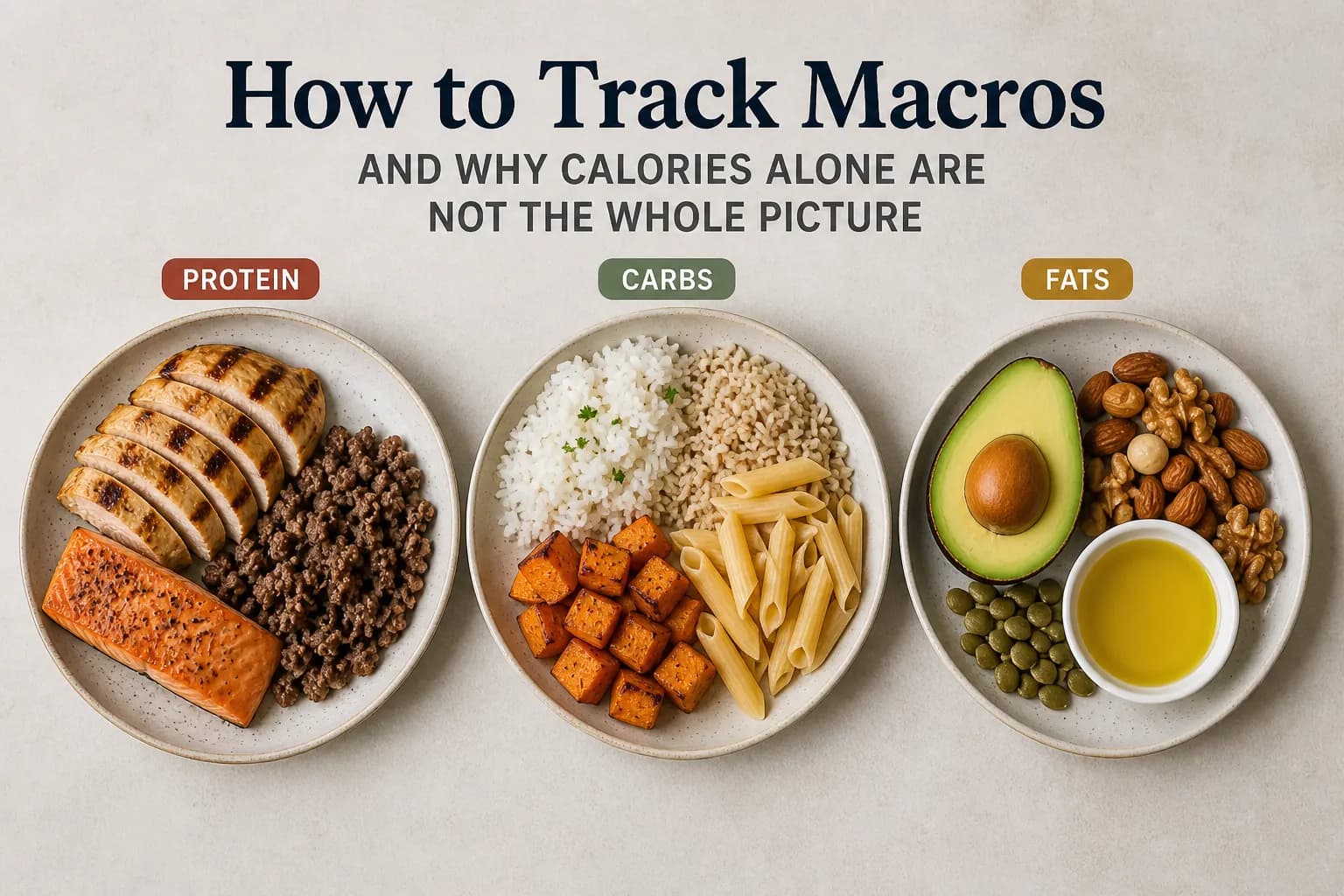
TL;DR. Calories decide whether you lose weight. Macronutrients, meaning protein, carbohydrates, and fat, influence what you lose and how you feel during the process. The research is consistent on three points: protein around 1.6 grams per kg of body weight (about 0.73 g/lb) is a strong target for supporting lean mass during resistance training, carbohydrates fuel exercise performance and brain function, and dietary fat should not be pushed too low for long periods. This article walks through what each macro actually does, how much you need, and how to track without turning every meal into a math problem.
A common pattern: someone loses 15 lbs on a calorie deficit and is disappointed when they look in the mirror. They expected to feel athletic, energetic, defined. Instead they look softer than expected, feel exhausted in the gym, and notice their mood has flattened. They cut calories, and that part worked. They did not pay attention to what those calories were made of.
This is the gap that macros close. Calories are the budget. Macronutrients are how you spend the budget, and the spending pattern helps decide whether you end up leaner and stronger or just smaller and softer.
A note before reading. If you have a history of disordered eating, are in recovery, or notice yourself becoming preoccupied with food rules and numbers, macro tracking can intensify rigid or perfectionistic thinking patterns. Many clinicians recommend avoiding structured tracking in those situations and working with a registered dietitian or therapist instead. The information below is for general educational purposes. It is not a prescription.
What macros actually are and why they matter
Three macronutrients provide all the energy in your diet:
- Protein: 4 calories per gram. Builds and repairs muscle, hair, skin, enzymes, hormones, and immune cells. The most metabolically expensive nutrient to digest.
- Carbohydrates: 4 calories per gram. The body's preferred fuel for moderate-to-high-intensity exercise and the brain's primary energy source.
- Fat: 9 calories per gram. Supports hormone production, cell membrane structure, vitamin absorption, and long-duration energy.
Calorie counts treat all three as interchangeable. They are not. A 2,000-calorie day made of 100g protein, 250g carbs, and 67g fat produces a very different physiological outcome than a 2,000-calorie day made of 50g protein, 350g carbs, and 56g fat, even though the calorie totals match.
This is the mechanism behind one of the most consistently replicated findings in nutrition research: during weight loss, higher-protein diets tend to preserve more lean mass than lower-protein diets, especially when combined with resistance training1. The calories explain whether you lose weight at all. The macros help explain what kind of weight you lose.
Protein: the macro that determines what you lose
If you are going to optimize one macro, optimize this one.
What it does
Protein supplies amino acids that the body uses to repair and build tissue, including muscle. During weight loss, the body draws on both fat stores and muscle stores for energy. How much of each it draws on is heavily influenced by two factors: how much protein you are eating, and whether you are doing resistance training. Get both right and more of the lost weight comes from fat. Get them wrong and a meaningful share of the lost weight can come from muscle, which is the "smaller, softer version of yourself" outcome.
How much you actually need
The most-cited threshold in the muscle-building literature comes from a 2018 systematic review and meta-analysis published in the British Journal of Sports Medicine. Researchers analyzed 49 studies with 1,863 participants and identified a "breakpoint" at approximately 1.6 g/kg/day (about 0.73 g/lb), above which additional protein produced no further average gains in fat-free mass during resistance training2.
For weight loss specifically, a 2024 systematic review and meta-analysis in Clinical Nutrition ESPEN analyzed 47 studies with 3,218 participants and found that intakes above 1.3 g/kg/day helped preserve or increase muscle mass during weight loss, while intakes below 1.0 g/kg/day were associated with a significantly higher risk of muscle mass decline3.
The International Society of Sports Nutrition's position stand on protein and exercise recommends 1.4 to 2.0 g/kg/day as the general range for active individuals, with higher intakes sometimes used by resistance-trained individuals during cutting phases who want to maximally preserve lean mass4.
In practical numbers for someone weighing 80 kg (176 lb):
- Minimum to support muscle during weight loss: about 104 g/day (1.3 g/kg)
- Standard target for active people: about 128 to 144 g/day (1.6 to 1.8 g/kg)
- Aggressive cut with a lean-mass focus: about 160 to 200 g/day (2.0 to 2.5 g/kg)
The common advice to eat "0.8 grams per pound of body weight" puts you at 1.76 g/kg, which sits solidly within the useful range for someone who is training and cutting.
Why protein is metabolically special
Two effects make protein useful beyond just preserving muscle:
Higher thermic effect of food. A 2004 review in the Journal of the American College of Nutrition concluded that protein has a substantially higher thermic effect than carbohydrate or fat, meaning the body burns more calories digesting and metabolizing it5. Estimates put protein's thermic effect at roughly 20 to 30% of its caloric content, compared to 5 to 10% for carbs and 0 to 3% for fat.
Stronger satiety per calorie. The same review found convincing evidence that higher-protein meals increase satiety compared to lower-protein meals, and the weight of evidence suggested that higher-protein meals can reduce subsequent energy intake5. That does not mean protein magically causes fat loss, but it helps explain why higher-protein diets are often easier to sustain during a calorie deficit.
How to actually hit it
Most people fail at protein not because they do not try, but because they underestimate how much food it requires. A few reference points:
- A palm-sized portion of cooked chicken breast or fish is roughly 25 to 30g of protein.
- A cup of Greek yogurt is roughly 18 to 20g.
- A 4 oz cooked steak is roughly 30g.
- Three large eggs are roughly 18g.
- A scoop of whey protein is typically 20 to 25g.
To hit 130g of protein in a day, you are looking at four palm-sized meals' worth of protein, plus some yogurt or a shake. That is a lot more deliberate eating than most people default to without tracking. This is one of the biggest reasons tracking macros is more useful than tracking calories alone: it surfaces how often people are dramatically under-eating protein without realizing it.
Carbohydrates: the macro that fuels your performance and your mood
Carbs have spent the last two decades being culturally demonized, which is unfortunate because for most active people the right amount of carbs is the difference between training that gets results and training that drains them.
What they do
Carbohydrates are converted into glucose, which fuels:
- High-intensity exercise, like lifting, sprinting, and intervals. The body burns carbs much faster than it can mobilize fat for these efforts.
- Brain function. The brain uses about 120 grams of glucose per day at rest, and while it can adapt to using ketones in the absence of carbs, that adaptation takes time and produces measurable cognitive effects in the meantime.
- Recovery between training sessions, by replenishing muscle and liver glycogen.
A 2025 systematic review in Cureus looked at 19 studies of low-carbohydrate diets in athletes and found mixed results: some studies showed maintained or improved strength performance on low-carbohydrate diets, while endurance and high-intensity performance outcomes were inconsistent, and several studies showed performance decrements during the adaptation period6. The bottom line: if you train hard, cutting carbs aggressively is a gamble. Sometimes performance holds, but often it degrades, particularly in the first weeks before any metabolic adaptation has occurred.
How much you actually need
Carbs are the most flexible macro. They are not "essential" in the strict biochemical sense because the body can synthesize glucose from protein and fat, but functionally, most active adults perform better with 3 to 5 g/kg/day of carbs, and endurance athletes often need significantly more.
For weight loss, carbs become the lever you adjust after protein and fat are set. The math:
- Set protein based on body weight and goal (1.6 to 2.2 g/kg).
- Set fat at a sensible floor (40 to 60g for most adults, discussed below).
- Fill the rest of your calorie target with carbs.
This is the standard approach in evidence-based macro coaching, and it works because protein and fat have practical floors below which things can degrade, while carbs have a wider tolerable range.
What happens when you cut them too far
Several effects tend to show up:
- Training quality drops. Heavy lifts feel heavier, intervals feel harder, and you fatigue earlier in workouts.
- Mood can flatten. A 2009 study in Archives of Internal Medicine (now JAMA Internal Medicine) comparing very-low-carb and low-fat diets over one year found that mood improved more in the low-fat group than in the very-low-carb group, despite similar weight loss7. Low-carb works for many people in the short term, but mood is worth watching if carbs stay very low for months.
- Sleep can feel worse for some people. This is not as well established as the performance and mood findings, but some people notice changes in sleep quality when carbohydrate intake drops sharply.
For most people, the "carbs make you fat" framing is wrong. Excess calories make you fat. Carbs are simply one of the three sources those calories can come from, and for active people, often the most useful source.
Fat: the macro that keeps your hormones working
The 1990s low-fat diet era left a cultural residue that still shapes how a lot of people think about nutrition. The actual research is much less anti-fat than the cultural memory suggests.
What it does
Dietary fat has roles that no other macro can fill:
- Hormone production. Cholesterol, which the body synthesizes from fat and dietary precursors, is the substrate for testosterone, estrogen, progesterone, and other steroid hormones.
- Cell membrane integrity. Every cell in your body has a membrane made primarily of phospholipids.
- Fat-soluble vitamin absorption. Vitamins A, D, E, and K require dietary fat for proper absorption.
- Long-duration energy. Fat is the body's preferred fuel for low-intensity activity and at rest.
What happens when you cut it too low
This is where the data gets clearest, and most surprising to people who came of age during the fat-phobic 1990s. A 2021 systematic review and meta-analysis of intervention studies published in the Journal of Steroid Biochemistry and Molecular Biology found that low-fat diets significantly reduced total testosterone, free testosterone, urinary testosterone, and dihydrotestosterone levels in men compared to higher-fat diets8. The effect was meaningful enough that the authors recommended that men with low testosterone would be wise to avoid low-fat diets.
For women, dietary fat is also part of maintaining reproductive hormone balance, but it is important not to oversimplify the mechanism. In female athletes, chronically low energy availability, low fat intake, heavy training load, or some combination of those can contribute to menstrual irregularity, low bone density, and overall hormonal disruption, a syndrome often discussed under Relative Energy Deficiency in Sport (RED-S).
How much you actually need
The practical minimum for most adults is roughly 0.6 to 0.8 g/kg/day, or about 20% of total calories, whichever is higher. For someone eating 2,000 calories per day, that is around 45 to 55 grams of fat as a floor. Going substantially below this floor for sustained periods is where hormonal concerns become more relevant.
The 40 to 60g/day range you will see referenced in evidence-based fitness coaching is derived from this calculation. It represents the floor at which many adults consuming a sensible 1,800 to 2,500 calorie diet maintain adequate fat intake. Going above 60g is fine; the problem is repeatedly going below the floor.
A note on fat quality
Once you hit your fat floor, what kind of fat matters for cardiovascular outcomes:
- Monounsaturated fats (olive oil, avocados, nuts): broadly associated with cardiovascular benefits.
- Polyunsaturated fats (fatty fish, walnuts, flax): provide essential omega-3s.
- Saturated fats (butter, fatty cuts of meat, full-fat dairy): context-dependent, with current guidance generally suggesting moderation.
- Trans fats (industrial, found in some processed foods): clearly negative; avoid.
For most people, hitting the total fat floor while leaning toward unsaturated sources is the practical sweet spot.
What this looks like on a plate
The hand-portion model is the easiest mental framework to use without a scale:
- Palm of protein (chicken, fish, lean beef, tofu, Greek yogurt): roughly 25 to 30g of protein per palm-sized portion for most adults.
- Fist of carbs (rice, pasta, potatoes, oats, fruit): roughly 30 to 40g of carbs per fist, depending on the food.
- Thumb of fats (olive oil, butter, nut butter, cheese): roughly 10 to 12g of fat per thumb.
- Vegetables on the side: minimal calorie contribution, high in fiber and micronutrients.
You are not avoiding food groups. You are balancing them. Build most meals around this template and you will land within range of most reasonable macro targets without doing math at every meal.
The scale comes in when you want precision, particularly for protein during the first few weeks of trying to hit a target, or for fat sources like oils and nut butters that can quietly exceed estimates. After 2 to 4 weeks of weighing common foods, most people develop reliable visual estimation skills and can shift toward periodic spot-checks rather than constant measurement.
How tracking macros differs from tracking calories
A few distinctions are worth understanding before you decide whether to track macros, calories, or neither:
Calorie tracking answers "am I in a deficit, maintenance, or surplus?" This is the foundational question for weight change.
Macro tracking answers "given that I am in a deficit or surplus, am I losing or gaining the right kind of weight, and am I supporting my training and hormones?" This is the next layer of resolution.
Pure macro tracking without calorie awareness generally does not work well for weight loss. You can hit your protein target while still being in a calorie surplus, and the weight goes up. The two work as a system, not as alternatives.
For most people, the practical sequence is:
- First few weeks: Track calories and protein. Hitting a protein floor while staying within a calorie target captures most of the benefit with the least cognitive overhead.
- Once that feels stable: Add fat tracking, mainly to make sure you are not accidentally going below your floor.
- If you are optimizing performance or body composition: Add carb tracking for completeness and adjustment.
The key insight: macros are layered, not all-or-nothing. You do not have to track all three with precision from day one for tracking to start producing benefits.
Where this can go wrong
A few patterns are worth flagging:
Tracking macros becomes more rigid than tracking calories. Hitting an exact macro split, say 40/30/30, every day requires more constant attention than just hitting a calorie target. Some people thrive on this structure; others find it intensifies food preoccupation in unhealthy ways.
Protein targets get inflated past the point of usefulness. Very high protein intakes above 2.5 g/kg/day do not produce additional muscle gains in most people, and can crowd out carbs and fats to the point where those macros fall below their useful floors. More is not always better.
Fat gets cut to "make room" for protein and carbs. This is the most common pattern in macro tracking gone wrong, and the one with the clearest negative consequences. Set your fat floor early, not as an afterthought.
Tracking never ends. Tracking is most useful as a calibration phase, typically 4 to 12 weeks during which you build a reliable mental model of portion sizes and macro distributions. After that, most people benefit from periodic check-ins rather than continuous logging. Lifelong tracking is not the goal. Awareness is.
Frequently asked questions
How much protein do I really need per day?
For weight loss with muscle preservation, aim for 1.6 to 2.2 g/kg of body weight per day (about 0.73 to 1.0 g/lb). For someone weighing 70 kg (154 lb), that is roughly 112 to 154g per day. The lower end of that range is typically enough for most active people; the higher end is for resistance-trained individuals during aggressive cutting phases.
Will eating too much protein hurt my kidneys?
Not in healthy adults. Long-term concerns about high-protein diets damaging kidneys come from research on people with pre-existing kidney disease, where protein restriction is part of treatment. In healthy individuals, protein intakes well above the RDA have not been shown to harm kidney function. If you have kidney disease, work with a clinician.
Should I count calories or macros?
For most people, both, but layered. Calorie awareness comes first, because it determines whether you lose, maintain, or gain weight. Protein tracking adds the second-most useful layer. Fat and carb tracking add the third. You do not need to track all three with precision to benefit from tracking; even just hitting a protein target while staying in a rough calorie range captures most of the benefit.
Are all carbs the same?
For total energy and macro purposes, yes. A gram of carbs from rice and a gram from a donut both provide 4 calories and count the same in your macro target. For health outcomes and satiety, no. Whole-food carbs (oats, beans, sweet potatoes, fruit) come with fiber, micronutrients, and slower digestion that processed carbs (sugary cereals, candy, white bread) lack. Track to a number; eat for quality.
Do I need to weigh my food?
For the first 2 to 4 weeks of tracking, a kitchen scale is genuinely useful because it teaches you what reasonable portions actually look like. After the calibration phase, most people can shift to visual estimation for most foods, with the scale reserved for high-calorie additions like oils, nut butters, and cheese, where small visual errors translate into large calorie differences.
Can I track macros without an app?
You can, but it is tedious. Even basic tracking benefits enormously from a database of food values. Most people who try paper tracking quit within two weeks; app tracking has much higher adherence rates simply because the friction is lower. A tool like Mindful is useful here because you can log what you ate and see calories, protein, carbs, and fat in the same place, which supports the layered approach described above.
What if my targets feel impossible to hit?
For most people, protein is the macro they consistently undershoot. The fix is usually one of three things: add a protein source to breakfast (most people front-load carbs and back-load protein), keep a default protein source on hand for snacks (Greek yogurt, cottage cheese, jerky, a shake), or anchor each meal around a palm-sized protein portion before adding the rest. If you are consistently coming up short by 30 to 50g/day, it is almost always because protein is not built into your default meals, not because the target is unrealistic.
Should I track on weekends and during holidays?
For most people, no. Research on dietary self-monitoring consistently finds that consistency over time matters more than any single day. Some people prefer tracking every day because the routine helps; others do better loosening tracking during high-stress or social eating periods to reduce burnout. Hit your weekly pattern, not a perfect daily target every day.
Where Mindful fits
Mindful calculates your protein, carb, and fat targets based on your body weight, activity level, and goal, so you do not have to manually decide between 1.6 and 2.0 g/kg of protein or work out how many grams of fat 20% of your calories represents. The dashboard shows your actual intake against those targets in real time, so you can adjust your next meal instead of finding out at the end of the week that you under-ate protein and over-ate carbs.
If you want a simple way to track calories, macros, and what you ate, Mindful is built for that.
References
Footnotes
-
Cava E, Yeat NC, Mittendorfer B. "Preserving Healthy Muscle during Weight Loss." Advances in Nutrition 8(3):511 to 519. May 2017. DOI ↩
-
Morton RW, Murphy KT, McKellar SR, Schoenfeld BJ, Henselmans M, Helms E, Aragon AA, Devries MC, Banfield L, Krieger JW, Phillips SM. "A systematic review, meta-analysis and meta-regression of the effect of protein supplementation on resistance training-induced gains in muscle mass and strength in healthy adults." British Journal of Sports Medicine 52(6):376 to 384. March 2018. DOI ↩
-
Kokura Y, Ueshima J, Saino Y, Maeda K. "Enhanced protein intake on maintaining muscle mass, strength, and physical function in adults with overweight/obesity: A systematic review and meta-analysis." Clinical Nutrition ESPEN 63:417 to 426. October 2024. DOI ↩
-
Jäger R, Kerksick CM, Campbell BI, et al. "International Society of Sports Nutrition Position Stand: protein and exercise." Journal of the International Society of Sports Nutrition 14:20. June 2017. DOI ↩
-
Halton TL, Hu FB. "The effects of high protein diets on thermogenesis, satiety and weight loss: a critical review." Journal of the American College of Nutrition 23(5):373 to 385. October 2004. DOI ↩ ↩2
-
Sultan ZH, Speelman D. "A Systematic Review of the Effects of Low-Carbohydrate Diet on Athletic Physical Performance Parameters." Cureus 17(2):e79166. February 2025. DOI ↩
-
Brinkworth GD, Buckley JD, Noakes M, Clifton PM, Wilson CJ. "Long-term effects of a very low-carbohydrate diet and a low-fat diet on mood and cognitive function." Archives of Internal Medicine 169(20):1873 to 1880. November 2009. DOI ↩
-
Whittaker J, Wu K. "Low-fat diets and testosterone in men: Systematic review and meta-analysis of intervention studies." Journal of Steroid Biochemistry and Molecular Biology 210:105878. June 2021. DOI ↩