What Cristiano Ronaldo Eats in a Day: Reported Diet, Calories, and Macros
Cristiano Ronaldo's exact current daily menu is not public, but former-chef reporting gives enough detail to build a realistic Ronaldo-inspired training day with calories, macros, and context.
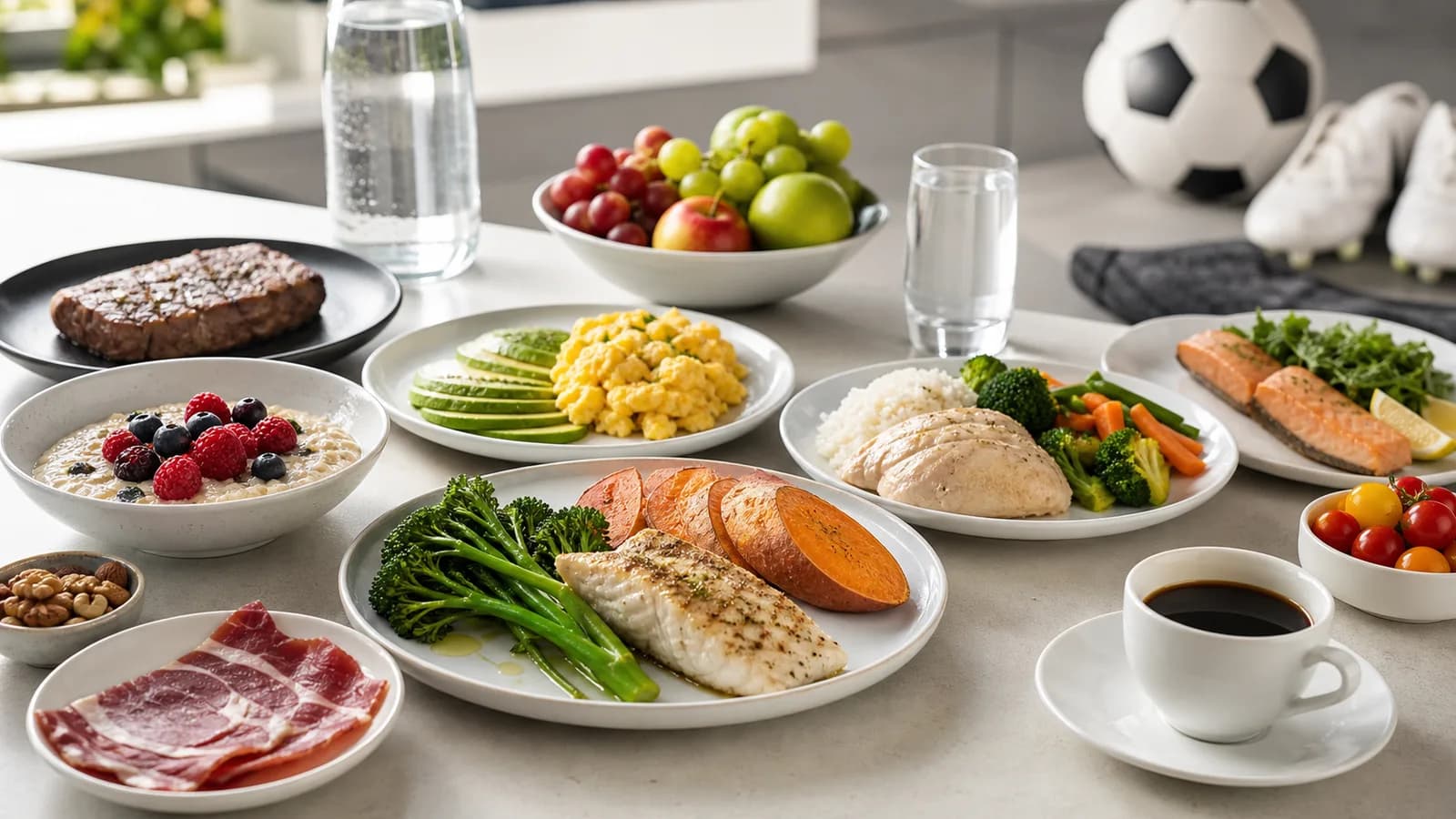
TL;DR. Cristiano Ronaldo's exact current daily diet is not public. The best available public detail comes from people who say they cooked for him: former Manchester United chef Kelly Johnson and former private chef Giorgio Barone. Their reported pattern is strict, high-protein, mostly whole-food, and built around fish, chicken, eggs, avocado, sweet potato, rice, vegetables, fruit, water, black coffee, and very little sugar, fried food, processed food, or carbonated drinks12. A realistic Ronaldo-inspired training day lands around 3,000 to 3,600 calories, with roughly 160 to 200g protein, 330 to 450g carbs, and 80 to 110g fat, depending on training load, match schedule, portions, and whether the day includes more rice, sweet potato, or fruit.
Quick answer: reported Ronaldo foods include coconut-milk porridge, an omelet with five egg whites and one yolk, avocado and eggs, fish with sweet potato and tenderstem broccoli, steamed skinless chicken, boiled rice, salmon, vegetables, fruit, water, black coffee, small amounts of red meat, Iberico ham, and dry-aged wagyu as higher-end favorites12. The sample day below is about 3,190 calories, 184g protein, 362g carbs, and 96g fat.
Ronaldo is different from a lot of athlete-diet search topics because there is more public reporting than usual. That does not mean we know his exact breakfast today. It means there are enough attributed details to build a careful article without pretending every gram is confirmed.
So this piece separates three things:
- What former chefs are reported as saying
- What sports nutrition says a footballer still needs
- A practical meal-by-meal template that uses reported foods without turning them into a fake leaked menu
A note before reading. This article is general nutrition education, not medical advice or a claim to know Ronaldo's private diet. Nutrition values are rounded estimates from USDA FoodData Central and common label values, so exact numbers will vary by brand, cooking method, portion size, and food preparation3. If you have a medical condition, a history of disordered eating, or a sport-specific performance goal, work with a qualified clinician or registered dietitian.
What public reporting actually says
Ronaldo diet content often gets copied from blog to blog. The useful way to read it is to rank claims by source strength.
Kelly Johnson gives the most meal-specific reporting. In a 2026 report by The Sun, Johnson, described as a former senior chef at Manchester United, said Ronaldo was the strictest player he cooked for. The reported staples included coconut-milk porridge, salmon, chicken, boiled rice, sweet potato wedges, tenderstem broccoli, and fruit. Johnson also described a breakfast omelet with five egg whites and one yolk, a training-day plate of fish with sweet potato and broccoli, and a matchday plate of steamed skinless chicken with boiled rice and vegetables1.
Johnson also named the indulgent foods. The same report says Ronaldo's preferred luxury foods included Iberico ham and dry-aged wagyu, while red meat was served in small quantities. That matters because it gives the article a sourced "favorite foods" section without pretending those foods are the base of the daily diet1.
Giorgio Barone adds a second former-chef pattern. The Sun Ireland, citing comments Barone gave to Covers.com, reported that Ronaldo's breakfast was avocado, eggs, and coffee with no sugar; lunch was chicken or fish with vegetables; and dinner was a light fish or meat fillet with vegetables. Barone also said Ronaldo did not eat sugar and avoided milk, pasta, bread, and flour in his approach2.
The water-and-soda story is real public context. At Euro 2020, Ronaldo moved Coca-Cola bottles away during a press conference and held up water, saying "Agua"4. That moment should not be overinterpreted as a full diet plan, but it supports the broader public picture: hydration and avoidance of sugary drinks are part of the Ronaldo food story.
The exact current menu is still private. Former-chef media reporting can tell us about foods and patterns. It cannot tell us Ronaldo's current daily intake, his matchday menu in Saudi Arabia, or the exact calories he eats today. That is why the sample plan below is Ronaldo-inspired, not Ronaldo-confirmed.
What to trust, what to treat carefully
Here is the quick source audit.
| Claim | How strong is it? | How this article uses it |
|---|---|---|
| Coconut-milk porridge, salmon, chicken, boiled rice, sweet potato, broccoli, fruit | Stronger reported detail from a named former Manchester United chef | Included directly in meals |
| Omelet with five egg whites and one yolk | Stronger reported detail from Johnson | Included at breakfast/snack |
| Fish with sweet potato and broccoli | Stronger reported detail from Johnson | Used as the main lunch |
| Steamed skinless chicken with rice and vegetables | Stronger reported detail from Johnson | Used as dinner/matchday option |
| Avocado, eggs, black coffee, no sugar | Reported by a named former private chef | Included at breakfast and source context |
| No milk, pasta, bread, or flour | Reported by Barone, but more restrictive than general sports-nutrition advice | Mentioned as an attributed chef claim, not universal advice |
| Six meals per day | Commonly repeated online, but less consistently sourced than specific foods | The article uses six meal slots as a practical structure, not a claim that every Ronaldo day has exactly six meals |
| Iberico ham and dry-aged wagyu | Reported by Johnson as preferred luxury foods | Included as planned favorite-food options |
This is the difference between useful celebrity nutrition and fan fiction. If the source says "fish with sweet potato and broccoli," we can use that. If the internet says "Ronaldo eats exactly six meals at these exact times," we should slow down.
A plausible calorie range
No reliable public source gives Ronaldo's current calorie target. For an elite footballer with his training history, muscle mass, and match schedule, the useful answer is a range, not one fake-precise number.
| Day type | Illustrative calories | Why |
|---|---|---|
| Rest or light recovery day | 2,600-3,100 | Less field output, fewer starch portions |
| Normal training day | 3,000-3,600 | Gym, pitch work, recovery, daily movement |
| Match day or heavy double-session day | 3,500-4,300+ | More carbohydrate before and after play, higher total output |
The sample day below lands around 3,190 calories, 184g protein, 362g carbs, and 96g fat. That is a high-protein, moderate-to-high-carbohydrate athlete template. It also reflects a tension in the public reporting: Ronaldo's reported meals are very lean and strict, but football still demands carbohydrate.
Soccer is an intermittent high-intensity sport. A review in Sports Medicine describes elite soccer as about 10 km of running in a 90-minute match with repeated sprints, changes of direction, jumps, tackles, and kicks5. The Academy of Nutrition and Dietetics, Dietitians of Canada, and ACSM position stand gives 5-7g/kg/day carbohydrate for moderate training and 6-10g/kg/day for 1-3 hours of moderate-to-high-intensity exercise6. Ronaldo's reported foods can still supply those carbs through oats, sweet potato, rice, fruit, and vegetables, even if pasta and bread are not central.
Protein also matters, but more is not automatically better. The International Society of Sports Nutrition position stand gives 1.4-2.0g protein/kg/day as sufficient for most exercising individuals and recommends spreading protein across the day7. The sample day is protein-forward because the reported Ronaldo foods are protein-forward.
The Ronaldo-inspired day at a glance
This is not a leaked Ronaldo menu. It is a meal-by-meal training day built from the reported foods and then rounded into practical calories and macros.
| Meal | Foods | Approx. calories | Approx. protein | Approx. carbs | Approx. fat |
|---|---|---|---|---|---|
| Breakfast | Coconut-milk porridge, berries, avocado, egg-white omelet, black coffee | 690 | 37g | 76g | 29g |
| Snack 1 | Fruit, water, small handful of nuts | 280 | 6g | 36g | 14g |
| Lunch | Fish, sweet potato, tenderstem broccoli, vegetables | 650 | 48g | 78g | 14g |
| Snack 2 | Five-egg-white-and-one-yolk omelet, fruit | 310 | 27g | 32g | 8g |
| Dinner | Steamed skinless chicken, boiled rice, vegetables | 740 | 55g | 105g | 9g |
| Supper | Salmon or light fish/meat fillet, vegetables, small fruit portion | 520 | 42g | 35g | 22g |
| Total | 3,190 | 184g | 362g | 96g |
The structure matches the reporting:
- Breakfast is strict, high-protein, and low-sugar.
- Lunch uses the fish, sweet potato, and broccoli plate Johnson described.
- Dinner uses the steamed chicken, rice, and vegetables matchday-style plate.
- Snacks fill the gap without fried, processed, or sugary foods.
- Supper is a light protein-and-vegetable finish, similar to Barone's reported dinner pattern.
Now, meal by meal.
Breakfast: coconut porridge, eggs, avocado, and black coffee
Example meal
- Coconut-milk porridge with oats and berries
- Omelet made with egg whites and one whole egg or one yolk
- 1/2 avocado
- Black coffee, no sugar
- Water
Approx. macros: ~690 calories, 37g protein, 76g carbs, 29g fat
This is the most source-backed breakfast in the article. Johnson reported coconut-milk porridge and an omelet made with five egg whites and one yolk; Barone reported avocado, eggs, and coffee with no sugar12.
The porridge supplies carbohydrate. The egg-white-heavy omelet adds protein without much fat. The avocado adds fat, potassium, and satiety. Black coffee fits Barone's reported "no sugar" detail.
The coconut milk is worth handling carefully. Coconut milk can make porridge calorie-dense quickly, especially if it is canned full-fat coconut milk rather than a thinner carton beverage. For a regular reader trying to lose weight, the same breakfast could be scaled down by using a smaller oat portion, a lighter coconut milk, and less avocado.
Snack 1: fruit, water, and a small handful of nuts
Example meal
- 1 banana, apple, orange, or bowl of berries
- 1/2 to 1 oz nuts
- Water
Approx. macros: ~280 calories, 6g protein, 36g carbs, 14g fat
Johnson's reported staples included fruit, and Ronaldo's public water moment at Euro 2020 makes water a fair part of the story14. This snack is modeled, but it fits the pattern: simple, portable, not fried, not sugary, not carbonated.
The nuts are not a confirmed Ronaldo food in the sources used here. They are included as a practical way to add calories and minerals without turning the snack into processed food. If you want to keep the snack closer to the reported list, use fruit and water only.
Lunch: fish, sweet potato, and tenderstem broccoli
Example meal
- 180g fish
- Sweet potato
- Tenderstem broccoli
- Extra vegetables or salad
- Water
Approx. macros: ~650 calories, 48g protein, 78g carbs, 14g fat
This is the cleanest meal in the Ronaldo source record. Johnson described a training-day plate of 180g fish, sweet potato, and tenderstem broccoli1.
From a sports-nutrition angle, it makes sense. Fish gives lean protein. Sweet potato provides carbohydrate, potassium, and a familiar whole-food starch. Broccoli adds fiber and micronutrients. The meal is strict without being low-carb.
The key is portion size. A small sweet potato makes this a light meal. A large sweet potato, extra fruit, or added rice turns it into a more appropriate meal for a hard training day. For regular readers, the plate works well because the protein and vegetables are clear and the starch is visible.
Snack 2: egg-white omelet and fruit
Example meal
- Omelet made with five egg whites and one yolk
- 1 piece of fruit
- Water or black coffee
Approx. macros: ~310 calories, 27g protein, 32g carbs, 8g fat
Johnson reported the five-whites-and-one-yolk omelet at breakfast, but it also works as a snack in a six-slot meal structure1. That is one of the benefits of building this as a template rather than pretending every meal time is fixed.
The egg whites make the snack protein-dense. The fruit adds carbohydrate without soda, candy, or a sweetened drink. It is very "Ronaldo-coded" in the public imagination: controlled, plain, and designed around performance rather than novelty.
If you are not an athlete, you may not need this much protein between meals. A smaller version could be two eggs, fruit, and water.
Dinner: steamed chicken, boiled rice, and vegetables
Example meal
- Skinless steamed chicken breast
- Boiled rice
- Mixed vegetables
- Water
Approx. macros: ~740 calories, 55g protein, 105g carbs, 9g fat
Johnson reported this as a matchday-style meal: skinless steamed chicken with boiled rice and vegetables1. It is plain, but that is part of the point. Before a match, players usually want familiar food that digests predictably.
Chicken supplies lean protein. Rice supplies carbohydrate without much fiber or fat, which can be helpful around competition. Vegetables add color and micronutrients, though a player may adjust the amount depending on timing and digestion.
For a rest day, reduce the rice. For a heavy training day, keep the rice or add more fruit. For weight loss, do not remove the rice automatically; measure it first and decide based on your total calories.
Supper: salmon or a light fillet with vegetables
Example meal
- Salmon, white fish, or a small lean meat fillet
- Vegetables or salad
- Small fruit portion if total carbs are low
Approx. macros: ~520 calories, 42g protein, 35g carbs, 22g fat
Barone described a light dinner pattern built around fish or meat fillet with vegetables2. In this sample day, that becomes an optional sixth meal or later supper.
Salmon makes the meal higher in fat and calories. White fish makes it lighter. A small steak can fit too, especially because Johnson reported red meat was served in small quantities1. The important part is that this is not a late-night dessert replacement or a grazing session. It is a planned recovery meal.
For most regular readers, supper is optional. If dinner already handled protein and calories, skip it. If training ended late or dinner was early, this kind of small meal can be useful.
Where Ronaldo's favorite foods fit
The best-sourced "favorite food" details in this research were not a daily breakfast or lunch. They were higher-end foods Johnson said Ronaldo liked: Iberico ham and dry-aged wagyu1.
Those foods can fit, but they need context.
| Food | How it fits | Why it is not the daily base |
|---|---|---|
| Iberico ham | Small serving with fruit, vegetables, or a simple starch | Salty and calorie-dense; better as a flavor/occasion food |
| Dry-aged wagyu | Small steak portion at dinner | High fat and calorie density; Johnson said red meat was kept in small amounts |
| Red meat generally | Small serving in a meal with vegetables | Fits occasionally, but the reported everyday pattern is more fish, chicken, rice, sweet potato, and vegetables |
This matters because a good Ronaldo article should not erase pleasure from the diet. The stricter daily pattern and the premium foods can both be true. The trick is scale: Iberico ham is a small plate, not the whole day. Wagyu is a portion, not a 16-ounce main event.
What Ronaldo appears to limit
Based on the former-chef reports and the Euro 2020 water moment, the best-supported limits are:
- Sugary drinks and carbonated drinks
- Fried foods
- Highly processed foods
- Added sugar
- Large red-meat portions
- Pasta, bread, flour, and milk, according to Barone's reported approach
That last line needs a caveat. Avoiding milk, pasta, bread, and flour is an attributed Ronaldo-chef claim, not a rule everyone should copy. Many athletes use milk, pasta, bread, and flour-based foods effectively. For Ronaldo, the reported approach seems to favor rice, sweet potato, oats, fruit, vegetables, fish, chicken, eggs, and selected fats instead.
How to adjust the Ronaldo-inspired day
For a match day
Make the day more digestible and more carb-aware.
- Keep rice, sweet potato, fruit, and porridge as the main carb sources.
- Keep fried food and heavy sauces away from the match window.
- Use lower-fiber vegetables closer to kickoff if digestion is sensitive.
- Keep water consistent, and use electrolytes when heat or sweat rate demands it.
For a rest day
Lower starch before cutting protein.
- Reduce rice or sweet potato portions.
- Keep fish, chicken, eggs, vegetables, and fruit.
- Keep higher-fat favorites like wagyu and Iberico ham measured.
- Do not force six meals if hunger and calories do not require it.
For fat loss
Do not copy an elite footballer's calories.
- Use the food quality and structure, not the total intake.
- Keep protein at meals.
- Measure coconut milk, avocado, nuts, ham, steak, and oils.
- Choose one main starch portion per meal.
- Use the calorie and macro calculator before guessing.
For soccer training
Pair this with the right work. Ronaldo's reported diet is famously disciplined, but food supports training rather than replacing it. If you want to compare how elite-player nutrition changes by body size and role, read the Messi diet breakdown and the Mbappé diet breakdown.
Frequently asked questions
What does Cristiano Ronaldo eat for breakfast?
Former-chef reporting points to coconut-milk porridge, eggs, avocado, and black coffee with no sugar. Johnson reported an omelet with five egg whites and one yolk, while Barone reported avocado, eggs, and coffee12.
How many calories does Ronaldo eat per day?
No reliable source publishes Ronaldo's exact calorie target. For the modeled normal training day in this article, a plausible illustrative range is about 3,000-3,600 calories, lower on a rest day and higher on a match or heavy double-session day.
What are Ronaldo's macros?
His exact macros are not public. The sample day here is about 184g protein, 362g carbs, and 96g fat. That is a high-protein, whole-food athlete template based on reported foods, not a universal prescription.
Does Cristiano Ronaldo eat sugar?
Former private chef Giorgio Barone reportedly said Ronaldo does not eat sugar, and the Euro 2020 water moment supports his public image as someone who avoids sugary drinks24. Treat that as Ronaldo's reported discipline, not a medical rule that every person must follow perfectly.
Does Ronaldo eat pasta or bread?
Barone reportedly said Ronaldo avoided pasta, bread, and flour in his approach2. That does not mean pasta or bread are bad for athletes. It means Ronaldo's reported pattern appears to rely more on rice, sweet potato, oats, fruit, and vegetables for carbohydrate.
What are Ronaldo's favorite foods?
The best-sourced favorite-food details in this research are Iberico ham and dry-aged wagyu, reported by former Manchester United chef Kelly Johnson1. They fit better as planned small portions or occasional premium foods than as the foundation of a daily performance diet.
Should regular people eat like Ronaldo?
Most people should not copy Ronaldo's calories or strictness. Copy the useful structure: protein at meals, planned carbs, vegetables, water, limited sugary drinks, and favorite foods in deliberate portions.
Where Mindful fits
Ronaldo's food story is really a structure story.
You do not need a private chef to notice whether breakfast is mostly sugar, whether snacks are unplanned, whether protein is uneven, whether carbs support training, or whether premium foods are quietly changing your calorie total.
Mindful lets you log meals and see calories, protein, carbs, and fat together, so you can build your own version of the structure without trying to live like a professional footballer.
References
Footnotes
-
The Sun. "How to eat like Cristiano Ronaldo: Man Utd legend's old chef reveals six favourite meals that keep him ripped aged 41." May 5, 2026. Reporting attributed to former Manchester United chef Kelly Johnson. Source ↩ ↩2 ↩3 ↩4 ↩5 ↩6 ↩7 ↩8 ↩9 ↩10 ↩11 ↩12 ↩13
-
The Sun Ireland. "Cristiano Ronaldo's ex-chef reveals secrets to his ripped body at 41 and common drink he avoids - 'it is against nature'." April 23, 2026. Reporting attributed to former private chef Giorgio Barone, citing his comments to Covers.com. Source ↩ ↩2 ↩3 ↩4 ↩5 ↩6 ↩7 ↩8
-
USDA. FoodData Central. Nutrition database used as a baseline for rounded food estimates. Source ↩
-
The Guardian. "Coca-Cola's Ronaldo fiasco highlights risk to brands in social media age." June 18, 2021. Reporting on Ronaldo moving Coca-Cola bottles and holding up water at Euro 2020. Source ↩ ↩2 ↩3
-
Stølen T, Chamari K, Castagna C, Wisløff U. "Physiology of soccer: an update." Sports Medicine 35(6):501-536. 2005. PubMed ↩
-
Thomas DT, Erdman KA, Burke LM. "Nutrition and Athletic Performance." Medicine & Science in Sports & Exercise 48(3):543-568. March 2016. Position stand from the Academy of Nutrition and Dietetics, Dietitians of Canada, and the American College of Sports Medicine. DOI ↩
-
Jäger R, Kerksick CM, Campbell BI, et al. "International Society of Sports Nutrition Position Stand: protein and exercise." Journal of the International Society of Sports Nutrition 14:20. June 2017. DOI ↩