What Kylian Mbappé Eats in a Day: Reported Food Context, Calories, and Macros
Kylian Mbappé's exact daily diet is not public, but his listed size, one reported food preference, and elite soccer demands can inform a modeled Mbappé-inspired training day with calories and macros.
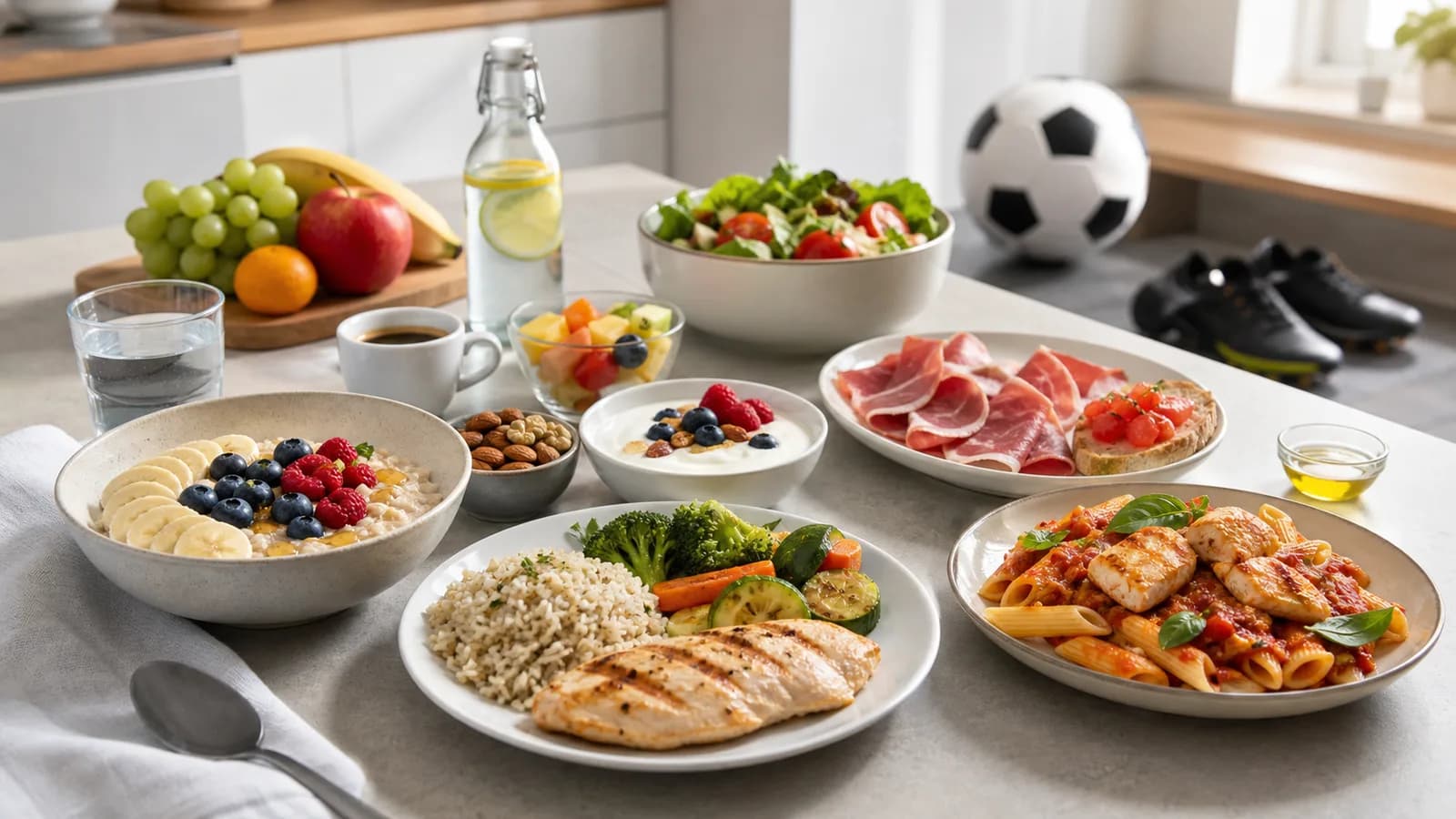
TL;DR. Kylian Mbappé's exact private meal plan is not public. What is public: Real Madrid lists him as a 75 kg, 1.78 m forward1, and AS, in secondary coverage of an Ibai Llanos video, reported that he said he loves jamón and has tried to find the best places to eat it since arriving in Spain2. From there, the honest way to build a "what Mbappé eats in a day" article is to separate reported food context from a modeled elite-forward training day. A realistic Mbappé-inspired day lands around 3,000 to 3,500 calories, with roughly 140 to 160g protein, 430 to 520g carbs, and 70 to 95g fat, depending on training load, match schedule, and portions.
Quick answer: Mbappé's exact breakfast, lunch, dinner, and macros are not reliably published. A practical Mbappé-inspired training day could look like oats, fruit, and eggs at breakfast; a small jamón-and-tomato-bread snack or fruit-and-yogurt snack; chicken or fish with rice and vegetables at lunch; a carb-plus-protein smoothie in the afternoon; then pasta or potatoes with fish, chicken, or lean beef at dinner. The sample day below is about 3,110 calories, 151g protein, 468g carbs, and 74g fat.
There is a big difference between a celebrity diet article and a sports nutrition article.
A celebrity version would pretend we know Mbappé's exact plate at every meal. We do not. His club, staff, travel schedule, match calendar, recovery status, and personal life are private. The public record does not support a leaked "Mbappé meal plan."
A useful version asks a better question: given what is actually reported, what would a sensible day of eating look like for a 75 kg elite forward whose game depends on acceleration, repeated sprinting, finishing, and recovery?
That is the approach here. First, we cover what reliable sources actually say. Then we turn that evidence into a meal-by-meal template with calories, macros, and context around the foods.
A note before reading. This article is general nutrition education, not medical advice or a claim to know Mbappé's private diet. Nutrition values are rounded estimates from USDA FoodData Central and common label values, so exact numbers will vary by brand, cooking method, portion size, and food preparation3. If you have a medical condition, a history of disordered eating, or a sport-specific performance goal, work with a qualified clinician or registered dietitian.
What reliable sources actually say
Mbappé has far less public diet reporting than Lionel Messi. That makes the evidence boundary important.
Real Madrid gives us the body-size anchor. Mbappé's official Real Madrid profile lists him as a forward, 75 kg, and 1.78 m1. That does not tell us what he eats, but it lets us scale a performance template to a realistic body size.
The clearest reported food preference is jamón. AS covered a video from Ibai Llanos in which Mbappé received jamón ibérico and manchego cheese. In that secondary report, AS said Mbappé expressed that he loves jamón and that since arriving in Spain he has tried to find the best places to eat it2. That is a real food-context detail, but it is not the same as saying jamón is a daily diet staple.
There is no credible public source for an exact daily menu. You will find posts online claiming Mbappé eats chicken, pasta, rice, fish, eggs, and vegetables in a precise routine. Those foods are plausible for a footballer. The precision is the problem. Without a direct source, the responsible wording is "Mbappé-inspired," not "Mbappé eats this every day."
The sports demand is high-carb by nature. Soccer is not steady jogging. A review in Sports Medicine describes elite soccer as roughly 10 km of running in a 90-minute match, with repeated explosive actions like sprinting, turning, jumping, kicking, and changing pace4. That is why the sample day below is built around planned carbohydrates, not just lean protein and vegetables.
Protein matters, but it should not crowd out fuel. The International Society of Sports Nutrition position stand gives 1.4-2.0g protein/kg/day as sufficient for most exercising individuals and recommends distributing protein across the day5. For a 75 kg player, that is about 105-150g daily protein. The sample day is right at the upper end after rounding, and can be lowered by trimming portions of yogurt, fish, or chicken.
Carbohydrate targets move with workload. The Academy of Nutrition and Dietetics, Dietitians of Canada, and ACSM position stand gives 5-7g/kg/day carbohydrate for moderate training and 6-10g/kg/day for 1-3 hours of moderate-to-high-intensity exercise6. For a 75 kg player, that points to roughly 375-750g of carbohydrate depending on the day. The sample day lands at 468g, or about 6.2g/kg.
The honest conclusion: Mbappé's public diet record is thin, but the performance context is clear. A modeled elite-forward day at his size would generally be built around enough energy, planned carbs, distributed protein, hydration, and flexible meals that adjust to training and matches.
A plausible calorie range
No reliable source publishes Mbappé's exact calorie target. For a 75 kg elite forward, needs can swing widely by day. The ranges below are illustrative sports-nutrition ranges, not measurements of his actual expenditure.
| Day type | Illustrative calories | Why |
|---|---|---|
| Rest or light recovery day | 2,500-2,900 | Lower training load, fewer starch portions |
| Normal training day | 3,000-3,500 | Field work, gym, recovery, daily movement |
| Match day or heavy double-session day | 3,500-4,200+ | More carbohydrate before and after play, higher total output |
The sample day below sits around 3,110 calories, 151g protein, 468g carbs, and 74g fat. It is not a prescription for regular readers. It is a realistic athlete template scaled to Mbappé's listed body size and football demands.
For someone using this article for their own diet, copy the structure before you copy the calories: protein at meals, carbs around training, fruits and vegetables daily, and favorite foods placed deliberately instead of treated as an accident.
The Mbappé-inspired day at a glance
This is not a leaked Mbappé menu. It is a modeled training day that combines the limited public food reporting with credible sports-nutrition targets.
| Meal | Foods | Approx. calories | Approx. protein | Approx. carbs | Approx. fat |
|---|---|---|---|---|---|
| Breakfast | Oats, milk, banana, berries, egg | 680 | 28g | 108g | 16g |
| Snack 1 | Tomato bread, small serving of jamón, fruit | 360 | 16g | 48g | 12g |
| Lunch | Chicken or white fish, rice, vegetables, salad, olive oil, fruit | 780 | 36g | 120g | 18g |
| Snack 2 | Greek yogurt smoothie with fruit, oats, and honey | 330 | 20g | 62g | 3g |
| Dinner | Salmon, chicken, or lean beef with pasta or potatoes and vegetables | 780 | 38g | 105g | 22g |
| Supper | Cottage cheese or yogurt with kiwi | 180 | 13g | 25g | 3g |
| Total | 3,110 | 151g | 468g | 74g |
Every meal has a job:
- Breakfast starts carbohydrate availability and hydration.
- Snack 1 is where the reported jamón preference can fit without taking over the day.
- Lunch refuels with a clear protein, starch, vegetables, and fat source.
- Snack 2 bridges training and recovery.
- Dinner restores glycogen and supplies another protein feeding.
- Supper is optional and mostly useful when training, travel, or late matches make dinner timing awkward.
Now, meal by meal.
Breakfast: oats, fruit, eggs, and fluid
Example meal
- 80g rolled oats cooked with low-fat milk
- 1 banana
- 1 cup berries
- 1 whole egg
- Water or coffee
Approx. macros: ~680 calories, 28g protein, 108g carbs, 16g fat
There is no reliable source saying this is Mbappé's breakfast. It is included because it fits the job of breakfast for an elite-forward training day.
Oats, banana, berries, and milk put carbohydrate on the board early. The egg and milk add protein without turning breakfast into a heavy, slow meal. If training starts soon after breakfast, the fat and fiber could be reduced by using a smaller oat portion, skipping the egg, or choosing a simpler toast-and-fruit setup.
For a normal reader, this breakfast may be too large. You could make it more weight-loss-friendly by using 40-50g oats, keeping the fruit, and setting protein with your own protein target.
Snack 1: jamón, tomato bread, and fruit
Example meal
- 1-2 slices toasted bread with tomato
- 25-40g jamón
- 1 orange, apple, or banana
- Water
Approx. macros: ~360 calories, 16g protein, 48g carbs, 12g fat
This is the meal where the favorite-food reporting belongs.
AS, in secondary coverage of Ibai Llanos's video, reported that Mbappé showed clear enthusiasm for jamón and said he had been looking for good places to eat it in Spain2. That gives us enough evidence to mention jamón as a reported preference. It does not give us enough evidence to say he eats it every day.
From a performance angle, jamón works better as a small add-on than as the main protein of the day. It brings flavor, protein, and Spanish food context, but cured ham can also be salty and calorie-dense depending on the portion. Pairing a small amount with tomato bread and fruit makes it feel like a real snack while still leaving the major protein and carbohydrate work for lunch and dinner.
If this snack is close to training, a lower-fat version could be fruit, yogurt, and toast. If it is later in the day, the jamón version fits more comfortably.
Lunch: chicken or fish, rice, vegetables, and olive oil
Example meal
- 4-5 oz cooked chicken breast or white fish
- 2 cups cooked rice
- Large salad with tomatoes, greens, cucumber, carrots, and herbs
- 1 cup cooked vegetables
- 1 tablespoon olive oil
- 1 piece of fruit
Approx. macros: ~780 calories, 36g protein, 120g carbs, 18g fat
This lunch is modeled from soccer nutrition, not from a public Mbappé quote.
The rice is doing real work. For a footballer, carbohydrates are not a garnish; they help refill glycogen and support high-intensity running, especially when training sessions are long or repeated. Chicken or white fish gives a lean protein base. Vegetables and salad add volume, micronutrients, and fiber. Olive oil adds calories and helps make the plate easier to eat without adding a huge food volume.
For fat loss, reduce the rice to 1 cup and keep the protein and vegetables. For a heavy training day, keep the rice high or add bread.
Snack 2: yogurt smoothie with fruit, oats, and honey
Example meal
- Plain Greek yogurt
- 1 banana or mixed berries
- 20-30g oats
- 1 teaspoon to 1 tablespoon honey
- Water, milk, or ice to blend
Approx. macros: ~330 calories, 20g protein, 62g carbs, 3g fat
This is a practical footballer snack because it is easy to scale.
If the player needs more carbohydrate, add banana, cereal, oats, or honey. If the player needs more protein, use more yogurt or add milk. If training is soon, keep fat lower so the snack digests more easily.
This also helps distribute protein across the day, which lines up with ISSN's recommendation to spread protein feedings every 3-4 hours5. It is not magic. It is logistics: an athlete who waits until dinner to catch up on food is often making recovery harder than it needs to be.
Dinner: pasta or potatoes with fish, chicken, or lean beef
Example meal
- 4-5 oz salmon, chicken, white fish, or lean beef
- 2 cups cooked pasta or a large potato portion
- Tomato sauce, herbs, or vegetables
- Salad or cooked greens
- 1-2 teaspoons olive oil
Approx. macros: ~780 calories, 38g protein, 105g carbs, 22g fat
Dinner depends on the next day.
If the next morning is a hard session, pasta or potatoes make sense. If it is a recovery day, the starch portion can shrink. If there was a late match, this meal might be split into a post-match recovery snack and a later dinner.
The protein choice can rotate. Salmon adds more fat and omega-3s. Chicken or white fish keeps the meal lighter. Lean beef can fit, especially when the rest of the day is lower in saturated fat. The key is that dinner is not just "protein and salad." For a footballer, under-fueling carbohydrate can make the next training session feel flat.
Supper: optional recovery snack
Example meal
- 1/2 cup cottage cheese or plain yogurt
- 1 kiwi or other fruit
Approx. macros: ~180 calories, 13g protein, 25g carbs, 3g fat
There is no public source saying Mbappé eats supper. Treat this as an optional recovery snack.
It is useful when dinner was early, training ended late, or total protein is short. ISSN notes that pre-sleep casein protein can increase overnight muscle protein synthesis, though the dose in the position stand is higher than this small snack5. Cottage cheese and yogurt are practical casein-rich foods, but regular readers should not force a bedtime snack if they are not hungry and already hit their daily targets.
Why jamón is included but not centered
This is the place where sports editing matters.
The reported food detail is interesting because it makes the article more human. Mbappé living in Spain, receiving jamón in an Ibai video, and talking about finding good places to eat it is real cultural context2.
But one favorite food does not define an elite player's diet. A professional forward's daily plan has to solve bigger problems: energy availability, glycogen, recovery, hydration, digestion, travel, and match timing. That is why jamón appears as a small snack option instead of becoming the headline meal.
The better takeaway is not "eat jamón like Mbappé." It is: favorite foods can fit when the rest of the day is structured.
How to adjust the Mbappé-inspired day
For a match day
Raise carbohydrates and reduce digestive risk.
- Add more rice, pasta, bread, cereal, or potatoes.
- Keep pre-match meals familiar and lower in heavy fats.
- Use fruit, toast, sports drinks, or easy carbs close to kickoff if tolerated.
- Push larger salads and heavier fats farther from the match.
For a rest day
Lower the starch portions first.
- Reduce rice or pasta by 1/2 to 1 cup at lunch or dinner.
- Keep protein steady.
- Keep fruits and vegetables.
- Keep favorite foods measured instead of grazing.
For fat loss
Do not copy elite-athlete calories.
- Use the meal structure, not the total energy.
- Keep protein at each meal.
- Choose one main starch portion per meal.
- Measure oils, nuts, cheese, and cured meats.
- Use the calorie and macro calculator before guessing.
For soccer training
Pair food with the work. The diet supports speed, sprint repeatability, strength, and recovery; it does not replace training. If you want to understand the training side of an elite soccer routine, start with our Lionel Messi workout routine and adapt the principles to your own schedule.
Frequently asked questions
What does Kylian Mbappé eat for breakfast?
His exact breakfast is not public. A realistic athlete-style breakfast would include carbohydrates, fluid, and some protein, such as oats, fruit, milk or yogurt, and eggs.
How many calories does Mbappé eat per day?
No reliable source publishes Mbappé's calorie target. For the modeled normal training day in this article, a plausible illustrative range is about 3,000-3,500 calories, lower on a rest day and higher on a match or heavy double-session day.
What are Mbappé's macros?
His exact macros are not public. The sample day here is about 151g protein, 468g carbs, and 74g fat. That is a high-carbohydrate, protein-distributed football template, not a universal prescription.
What is Mbappé's favorite food?
The strongest sourced food-preference detail here is jamón. AS reported that in an Ibai Llanos video, Mbappé said he loves jamón and tries to find good places to eat it in Spain2. That supports including jamón as context, not claiming it is a daily staple.
Does Mbappé eat pasta?
There is no reliable public source saying pasta is part of his exact daily diet. Pasta is included here because it is a practical carbohydrate source for footballers, especially around hard training and matches.
Should regular people eat like Mbappé?
Most people should not copy the calories. A 75 kg elite forward has a workload very different from a desk-based adult. Copy the structure: planned protein, enough carbs for your activity, fruits and vegetables, and favorite foods in deliberate portions.
Where Mindful fits
The useful lesson from Mbappé's diet story is not celebrity imitation. It is evidence-aware structure.
You can enjoy foods you genuinely like and still build a day that supports your goals. The difference is knowing what the meal is doing: fueling training, recovering afterward, managing hunger, or simply fitting a favorite food into the bigger picture.
Mindful lets you log meals and see calories, protein, carbs, and fat together, so you can build your own version of the structure without pretending you live like a Real Madrid forward.
References
Footnotes
-
Real Madrid C.F. "Mbappé." Official player profile listing Kylian Mbappé as a forward, 75 kg, and 1.78 m. Source ↩ ↩2
-
AS / Tikitakas. "La sincera opinion de Kylian Mbappé sobre el plato más tipico en España: 'Intento buscar los mejores sitios'." September 22, 2025. Secondary reporting on Mbappé's comments about jamón in an Ibai Llanos video; AS also notes that he did not know manchego cheese. Source ↩ ↩2 ↩3 ↩4 ↩5
-
USDA. FoodData Central. Nutrition database used as a baseline for rounded food estimates. Source ↩
-
Stølen T, Chamari K, Castagna C, Wisløff U. "Physiology of soccer: an update." Sports Medicine 35(6):501-536. 2005. PubMed ↩
-
Jäger R, Kerksick CM, Campbell BI, et al. "International Society of Sports Nutrition Position Stand: protein and exercise." Journal of the International Society of Sports Nutrition 14:20. June 2017. DOI ↩ ↩2 ↩3
-
Thomas DT, Erdman KA, Burke LM. "Nutrition and Athletic Performance." Medicine & Science in Sports & Exercise 48(3):543-568. March 2016. Position stand from the Academy of Nutrition and Dietetics, Dietitians of Canada, and the American College of Sports Medicine. DOI ↩