15 Things That Aren't Worth the Calories (and What to Choose Instead)
A practical guide to foods and drinks that are easy to underestimate, with realistic U.S. servings, calorie comparisons, better alternatives, and exceptions for when they are worth it.
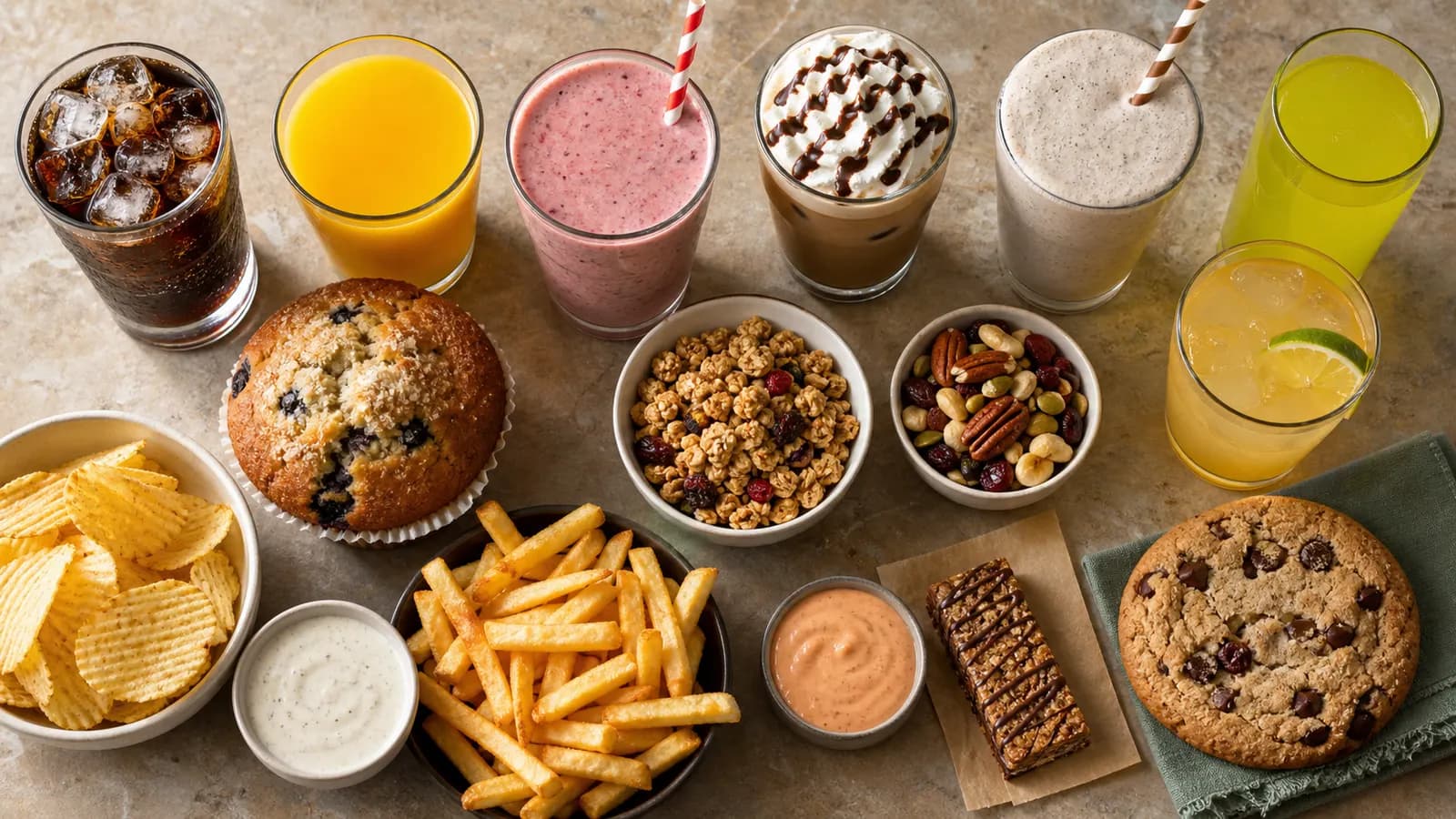
TL;DR. A food is usually not worth the calories when it disappears quickly, does little for hunger, and is not even the thing you really wanted. The clearest examples are liquid calories, automatic restaurant sides, unmeasured sauces, and packaged foods whose healthy image is stronger than their staying power. A 12 oz soda is 140 calories and an 8 oz orange juice is 110, while sparkling water is calorie-free and a whole orange is about 60 calories with more fiber and chewing involved123. That does not make soda or juice bad. It makes them worth choosing on purpose rather than by default.
“Not worth the calories” is deliberately subjective. A warm bakery cookie you love on vacation may be completely worth it. A stale meeting-room cookie eaten because it was there may not be. This guide is about finding the calories that add the least enjoyment, fullness, nutrition, or usefulness to your day—not ranking foods by moral value.
The numbers below use current U.S. product and restaurant nutrition information as concrete examples, plus USDA/common-label estimates for simple alternatives. Brands, recipes, pours, and portions vary, so use them as planning figures rather than promises4.
A note before reading. This article is general nutrition education, not a list of forbidden foods. If calorie comparisons or “worth it” decisions trigger anxiety, guilt, or restrictive behavior for you, skip the ranking exercise. Eat regularly and work with a registered dietitian or therapist if food decisions have become distressing.
The quick comparison
Every alternative below is meant to solve a similar job: something cold, sweet, crunchy, creamy, caffeinated, portable, or dessert-like. It will not always taste identical, and that is the point. If only the original will satisfy you, the more mindful choice may be to have it intentionally.
| Often not worth it by default | Example serving | Better everyday alternative | Approximate alternative calories |
|---|---|---|---|
| 1. Regular soda | 12 oz cola: 140 cal1 | Sparkling water, diet soda, or unsweetened iced tea | 0-5 |
| 2. Fruit juice | 8 oz orange juice: 110 cal2 | One medium orange plus water | ~60 |
| 3. Bottled smoothies and juice blends | 15.2 oz fruit smoothie: 240 cal, 2g protein5 | Nonfat Greek yogurt with berries | ~140-170 |
| 4. Sugary coffee drinks | Grande white chocolate mocha: 390 cal6 | Grande caffè latte with cinnamon | 190 |
| 5. Milkshakes and blended coffee drinks | Small vanilla shake: 480 cal7 | Small vanilla cone or Greek-yogurt smoothie | ~180-200 |
| 6. Caloric sports and energy drinks | 20 oz sports drink: 130 cal; 8.4 oz energy drink: 110 cal8 | Water, zero-sugar electrolyte drink, or coffee | 0-10 |
| 7. Sugary cocktails | Typical sweet cocktail: often 200-400+ cal9 | Spirit with soda water, or a 5 oz dry wine | ~100-130 |
| 8. Oversized bakery muffins | Coffee cake muffin: 590 cal10 | English muffin, eggs, and fruit | ~280-350 |
| 9. Granola used as a full bowl | 1 cup granola: often ~400-500 cal11 | Greek yogurt, fruit, and 2 tbsp granola | ~180-230 |
| 10. Trail mix eaten by the handful | 6 tbsp: ~300 cal12 | Fruit plus string cheese | ~140-180 |
| 11. Low-protein “health” bars | Two-bar granola pack: 200 cal, 4g protein13 | Greek yogurt or cottage cheese and fruit | ~140-190 |
| 12. Chips eaten straight from the bag | 1 oz potato chips: 160 cal14 | 3 cups air-popped popcorn with a protein dip | ~130-170 |
| 13. Default restaurant fries | Medium fries: 320 cal15 | Apple slices, vegetables, or a planned small fry | 15-230 |
| 14. Creamy dressings, aioli, and dips | 2 tbsp ranch: about 130 cal16 | Salsa or yogurt-herb dressing | ~10-50 |
| 15. Oversized bakery cookies and mediocre desserts | Large loaded cookie: about 800 cal17 | A favorite single-serving dessert or a shared portion | ~150-350 |
1. Regular soda
A 12 oz can of Coca-Cola contains 140 calories and 39g sugar. A 20 oz bottle contains 240 calories1. Soda is one of the clearest low-return calorie choices because it usually accompanies a meal without making the meal meaningfully more filling. Controlled research has found that caloric beverages can add to total meal energy without a matching reduction in food intake18.
Choose instead: sparkling water with citrus, unsweetened iced tea, water, or a zero-calorie soda if you enjoy it and tolerate non-nutritive sweeteners. This is a 140- to 240-calorie difference without changing the food on your plate.
When it may be worth it: the small glass of a regional soda you genuinely love, a float you are treating as dessert, or a full-sugar drink used to treat low blood sugar under appropriate medical guidance. The weak choice is the refill you barely notice, not every soda in every context.
2. Fruit juice
Fruit juice has vitamins and is not nutritionally identical to soda. It is still easy to drink quickly. An 8 oz serving of Simply Orange is 110 calories, 23g sugar, 2g protein, and no meaningful fiber2. A medium whole orange is roughly 60 calories, supplies fiber, and takes longer to eat3.
Choose instead: eat the orange and drink water. If you love juice, use a smaller 4 oz glass or dilute it with sparkling water. You keep the flavor while making the serving visible.
When it may be worth it: you need convenient carbohydrate around prolonged exercise, have difficulty eating enough, or simply prefer a measured glass with breakfast. “Whole fruit is usually more filling” does not mean juice has no place.
3. Bottled smoothies and juice blends
The word smoothie can make a bottle sound like a light snack even when it behaves more like several servings of fruit juice. A 15.2 oz Naked Green Machine is 240 calories, 49g sugar, 6g fiber, and 2g protein5. It contains fruit and micronutrients, but two grams of protein is a weak return if you bought it to bridge several hours of hunger.
Choose instead: use 3/4 cup nonfat Greek yogurt with berries, or blend yogurt, frozen fruit, water, and ice at home. A typical bowl or thick smoothie lands around 140 to 170 calories with substantially more protein3.
When it may be worth it: you need portable fuel, have a low appetite, are intentionally trying to increase energy intake, or choose a smoothie with a meaningful protein base. Read the entire-bottle serving and protein line, not just the fruit on the front.
4. Sugary coffee drinks
A grande Starbucks White Chocolate Mocha is 390 calories, 46g sugar, 17g fat, and 13g protein. A grande Caffè Latte is 190 calories with the same 13g protein6. The difference is mostly sauce and whipped cream, not coffee or milk.
Choose instead: a latte with cinnamon, an Americano with a measured splash of milk, cold brew with milk, or a version with fewer syrup pumps. This keeps the caffeine and creamy coffee structure without automatically making the drink dessert.
When it may be worth it: you actively want the mocha as a treat. Count it as the sweet part of the order and decide separately whether you also want the pastry. Our healthier Starbucks guide has more direct menu comparisons.
5. Milkshakes and blended coffee drinks
A small McDonald’s Vanilla Shake is 480 calories. The chain’s Vanilla Cone is 200 calories7. Both can be enjoyable desserts, but the shake is easy to mentally place in the drink category even though its calorie load is closer to a substantial food item.
Choose instead: if you want cold vanilla dessert, order the cone. If you want a filling smoothie, use Greek yogurt, fruit, and ice so protein is part of the structure. If you want blended coffee, choose a smaller size and skip the whipped topping.
When it may be worth it: a milkshake is the experience you came for, you are sharing it, or you need easy-to-consume energy. The point is to recognize it as dessert or fuel, not hydration.
6. Caloric sports and energy drinks
Gatorade’s current professional product guide lists a serving of Thirst Quencher powder at 130 calories and 34g carbohydrate and describes it as fuel for longer-duration, moderate- to high-intensity training or competition. An 8.4 oz Red Bull is 110 calories, 26g sugar, and 80mg caffeine8. Those calories have a job during demanding exercise; they are less useful during a commute or ordinary desk day.
Choose instead: water for routine hydration, a zero-sugar electrolyte option when you want the flavor or sodium, or coffee/tea when caffeine is the actual goal. That usually saves 100 to 140 calories per bottle or can.
When it may be worth it: long or intense training, heavy sweating, competition, illness-related fluid needs under medical advice, or rapid carbohydrate replacement. A sports drink is not pointless; it is often used in a situation that does not require sports fuel.
7. Sugary cocktails
Alcohol itself supplies calories, and juice, syrup, liqueur, cream, and large pours add more. The National Institute on Alcohol Abuse and Alcoholism includes margaritas, piña coladas, mojitos, whiskey sours, and other cocktails in its calorie calculator and notes that alcoholic drinks provide calories but few nutrients9. A restaurant cocktail commonly lands around 200 to 400 calories, with large frozen drinks potentially higher.
Choose instead: soda water with lime and a standard pour of spirits, a 5 oz dry wine, a light beer, or a zero-proof sparkling drink. If you drink alcohol, serving size matters more than the cocktail’s healthy-sounding fruit garnish.
When it may be worth it: the cocktail is part of a celebration or tasting experience and you truly want it. Skip alcohol entirely if you are pregnant, driving, taking an interacting medication, recovering from alcohol use disorder, or otherwise advised not to drink. This is a calorie comparison, not a recommendation to start drinking.
8. Oversized bakery muffins
Muffins can carry a breakfast reputation while functioning like cake. Dunkin’s U.S. nutrition guide lists its Coffee Cake Muffin at 590 calories, 24g fat, 88g carbohydrate, and 7g protein10. That is a large calorie spend for a breakfast that may not hold you for long.
Choose instead: an English muffin with eggs and fruit, or Greek yogurt, fruit, and toast. A practical version is roughly 280 to 350 calories and can provide two to three times the protein of the bakery muffin3.
When it may be worth it: it is an excellent muffin you intentionally chose, you split it, or you pair part of it with a protein source. The target is the oversized forgettable muffin grabbed because coffee shops label it breakfast.
9. Granola used as a full bowl
Granola contains useful ingredients such as oats, nuts, and seeds, but baking them with oil and sweeteners makes the finished food energy-dense. Quaker’s own preparation directions use 1/2 cup granola as one amount and 1 cup as two amounts11. Depending on the product, a full cup often lands around 400 to 500 calories before milk.
Choose instead: make Greek yogurt and fruit the base, then add 2 tablespoons of granola for crunch. That turns granola into a topping and keeps the whole bowl around 180 to 230 calories, depending on yogurt and fruit portions3.
When it may be worth it: you need compact trail fuel, struggle to eat enough, or measure a serving that fits your breakfast. Granola is not a bad food. Its tiny serving is simply easy to mistake for a cereal-bowl portion.
10. Trail mix eaten by the handful
Planters Nuts, Seeds & Cranberries Trail Mix contains 150 calories in 3 tablespoons12. Two casual handfuls can easily become twice that. The nuts and seeds provide nutrients, but trail mix was designed to pack portable energy into little space—the opposite of high-volume snacking.
Choose instead: fruit with a string cheese, or vegetables with a measured portion of nuts. You can land around 140 to 180 calories while getting more physical volume and a clearer stopping point.
When it may be worth it: you are hiking, traveling without refrigeration, need compact calories, or actually measure the portion. On a trail, the density is a feature. At a desk with an open family-size bag, it often is not.
11. Low-protein “health” bars
A health halo does not make a bar filling. A two-bar pouch of Nature Valley Peanut Butter Crunchy Granola Bars is 200 calories with 4g protein13. That can be a perfectly fine crunchy snack, but it is not a strong protein option just because nuts appear in the name.
Choose instead: Greek yogurt, cottage cheese with fruit, two hard-boiled eggs, or a bar that actually provides around 10g or more protein for a similar calorie range. Match the alternative to the job: portability, crunch, protein, or dessert.
When it may be worth it: you like the bar, need shelf-stable carbohydrate, or are eating it before activity. The problem is not the bar; it is expecting 4g of protein to behave like a high-protein meal bridge.
12. Chips eaten straight from the bag
A 1 oz serving of Lay’s Classic Potato Chips is about 160 calories, 10g fat, and 2g protein14. That amount can fit easily. The issue is the disappearing serving: a large bag removes the visual boundary between one ounce and three.
Choose instead: three cups of air-popped popcorn with a cottage-cheese herb dip, or plate one measured serving of the chips you actually want. Both options create a beginning and an end; popcorn plus protein generally gives more volume for roughly 130 to 170 calories3.
When it may be worth it: the oily potato crunch is exactly what you want. Plate it, eat it while paying attention, and enjoy it. See our healthier savory snack choices for more crunchy alternatives.
13. Default restaurant fries
McDonald’s lists medium fries at 320 calories and small fries at 230 calories15. Fries are not uniquely bad. They become a poor trade when they arrive automatically beside a meal you already wanted and you eat them lukewarm out of momentum.
Choose instead: apple slices, vegetables, side salad with a light dressing, no side, or the small fry when fries are part of the experience. The best alternative is often not a substitute food; it is removing the automatic add-on.
When it may be worth it: the restaurant makes exceptional fries, you want to share them, or fries are central to the meal. Order them hot and intentionally. Our guide to eating out and staying on track covers the rest of the restaurant math.
14. Creamy dressings, aioli, and dipping sauces
Hidden Valley lists about 130 calories per 2 tablespoons of Original Ranch16. Restaurant ramekins often hold more than two tablespoons, and aioli is commonly mayonnaise-based. Sauce can therefore add several hundred calories while being remembered as background.
Choose instead: salsa, mustard, hot sauce, lemon, vinegar, or Greek-yogurt herb dressing. Two tablespoons often land around 10 to 50 calories, depending on the choice. You can also keep the original and use half.
When it may be worth it: the sauce makes the meal. Great ranch with wings, aioli with excellent fries, or a dressing you love can earn its place. The low-return version is three sauces ordered automatically and barely tasted.
15. Oversized bakery cookies and mediocre desserts
Panera’s U.S. nutrition guide has listed a whole Kitchen Sink Cookie at roughly 800 calories17. Large bakery desserts are often designed for sharing, even when sold as one unit. The bigger problem is not merely size: a mediocre dessert can consume a large calorie budget without delivering a memorable dessert experience.
Choose instead: buy the dessert you genuinely want in a single-serving size, split the oversized item, save half before starting, or choose a smaller high-quality treat. The goal is not to replace dessert with fruit every time. It is to stop spending dessert calories on something you do not particularly like.
When it may be worth it: the cookie is fresh, special, and exactly what you wanted. Share it or eat the amount that satisfies you. If candy is the real craving, our healthier candy and chocolate choices offers whole-food alternatives without pretending fruit and candy are identical.
A better test than “Is this food bad?”
Before spending calories on an optional food or drink, ask four questions:
- Is it solving hunger, thirst, energy, convenience, or enjoyment? A choice without a job is easy to forget.
- Would I choose it if it were not already in front of me? This catches default fries, office cookies, refills, and open-bag grazing.
- Is there a version I would enjoy almost as much for meaningfully fewer calories? “Almost as much” matters. A joyless substitute is rarely useful.
- If only the original will do, what portion would feel complete? Sometimes the answer is the real item in a smaller or shared serving.
The best calorie swap is usually the one you do not experience as a punishment. For more examples by hunger and craving type, see healthy snacks under 200 calories.
How to log these foods without overthinking it
Use the full container when it is one serving. Bottled smoothies, energy drinks, and single cans are easy to log accurately. Check whether the label quietly lists more than one serving.
Measure calorie-dense foods a few times. You do not need to weigh granola, trail mix, sauces, and chips forever. Measuring them briefly teaches you what 2 tablespoons, 1 ounce, or 1/2 cup looks like.
Separate the parts of restaurant orders. Log the entrée, fries, drink, sauce, and dessert rather than searching for one perfect combo entry. This makes the optional calories visible.
Do not erase the original choice. If you had the shake or cookie, log it neutrally. A food record is useful when it reflects what happened, not when it becomes a scorecard. If you are deciding whether tracking suits you, read should you track your calories?.
Frequently asked questions
What foods are most often not worth the calories?
The most common low-return calories are sugar-sweetened drinks, unmeasured sauces, automatic restaurant sides, oversized bakery items, and energy-dense snacks eaten from large packages. They are not universally bad; they are simply easy to consume without much fullness or deliberate enjoyment.
Are liquid calories always worse than solid food?
No. Milk, protein shakes, meal-replacement drinks, smoothies, and sports drinks can serve real nutrition or performance needs. But research suggests beverages often produce weaker satiety than comparable solid foods and may add to a meal without causing people to eat less18. Context and composition matter.
Is diet soda a good alternative to regular soda?
It can be a practical zero-calorie swap if you enjoy it and tolerate the sweeteners. Water, sparkling water, coffee, and unsweetened tea are other options. You do not need diet soda to be healthy, and you do not need to fear it solely because it tastes sweet.
Should I avoid juice and smoothies?
Not automatically. Use a portion that matches the job. Juice is easy carbohydrate and fluid; a protein-based smoothie can be a real meal or recovery snack. Whole fruit is usually the stronger everyday choice when fullness is the goal.
What if the higher-calorie food is the one I really want?
Have it intentionally. Choose a portion, remove distractions, and let it count as the treat or side it is. Eating a disappointing substitute and then going back for the original can cost more calories and feel less satisfying than choosing the wanted food first.
How can I reduce drink calories without drinking only water?
Try sparkling water, unsweetened tea, coffee with measured milk, a smaller juice, a latte without multiple syrups, or zero-sugar versions of soda, sports drinks, and energy drinks. See how much water to drink for a broader hydration guide.
Where Mindful fits
“Worth it” is easier to judge when the pattern is visible. Mindful lets you log by photo, description, barcode, nutrition label, or manual entry, then correct the estimate when a portion or ingredient needs adjusting. The useful question is not whether one cookie was good or bad. It is whether drinks, sauces, sides, or grazing are repeatedly taking up calories you would rather spend somewhere else.
References
Footnotes
-
The Coca-Cola Company. “Coca-Cola Original.” Coca-Cola lists 140 calories and 39g sugar for 12 oz, and 240 calories and 65g sugar for 20 oz. Source ↩ ↩2 ↩3
-
The Coca-Cola Company. “Simply Orange Pulp Free.” The official U.S. label lists 110 calories, 26g carbohydrate, 23g total sugar, and 2g protein per 8 fl oz. Source ↩ ↩2 ↩3
-
Alternative calories are rounded planning estimates based on USDA FoodData Central entries and common U.S. labels for oranges, berries, nonfat Greek yogurt, eggs, English muffins, string cheese, popcorn, cottage cheese, salsa, mustard, and related foods. Exact totals depend on brand and portion. USDA FoodData Central ↩ ↩2 ↩3 ↩4 ↩5 ↩6
-
Product nutrition changes with formulation, size, customization, and preparation. The comparisons in this article use the cited U.S. labels or menu values as representative examples and USDA FoodData Central/common-label estimates for simple alternatives. Always check the package or restaurant listing for the item you actually consume. USDA FoodData Central ↩
-
Naked Juice. “Green Machine.” The official label lists 240 calories, 62g carbohydrate, 6g fiber, 49g total sugar, and 2g protein per 15.2 fl oz bottle. Source ↩ ↩2
-
Starbucks Coffee Company. Starbucks lists a grande White Chocolate Mocha at 390 calories, 46g sugar, 17g fat, and 13g protein, and a grande Caffè Latte at 190 calories and 13g protein. White Chocolate Mocha Caffè Latte ↩ ↩2
-
McDonald’s USA. McDonald’s lists a small Vanilla Shake at 480 calories and a Vanilla Cone at 200 calories. Vanilla Shake Vanilla Cone ↩ ↩2
-
Gatorade Sports Science Institute. The current product guide lists Gatorade Thirst Quencher powder at 130 calories and 34g carbohydrate per packet and describes its purpose as carbohydrate and electrolyte support for longer-duration, moderate- to high-intensity training or competition. Product guide Red Bull lists 110 calories, 26g sugar, and 80mg caffeine per 8.4 fl oz. Red Bull nutrition ↩ ↩2
-
National Institute on Alcohol Abuse and Alcoholism. “Alcohol Calorie Calculator.” NIAAA notes that alcoholic beverages supply calories but few nutrients and provides serving and calorie references for beer, wine, spirits, and cocktails. Actual restaurant recipes and pours vary. Source ↩ ↩2
-
Dunkin’. The U.S. nutrition guide lists one Coffee Cake Muffin at 590 calories, 24g fat, 88g carbohydrate, 2g fiber, 51g total sugar, and 7g protein. Nutrition guide ↩ ↩2
-
Quaker Oats. Quaker’s Simply Granola preparation directions show 1/2 cup for one amount and 1 cup for two, illustrating how quickly a cereal-bowl pour can double the intended portion. Formulations vary, so use the current package for exact calories. Source ↩ ↩2
-
Planters. “Nuts, Seeds & Cranberries Trail Mix.” Planters lists 150 calories, 10g carbohydrate, 2g fiber, and 5g protein per 3-tablespoon serving. Source ↩ ↩2
-
Nature Valley. “Peanut Butter Crunchy Granola Bars.” The official product page lists 200 calories and 4g protein per two-bar, 42g serving. Source ↩ ↩2
-
Frito-Lay. “Lay’s Classic Potato Chips.” The product page and USDA branded data list a typical 1 oz serving at about 160 calories, 10g fat, and 2g protein. Product page USDA entry ↩ ↩2
-
McDonald’s USA. McDonald’s lists medium World Famous Fries at 320 calories and small fries at 230 calories. Medium fries Small fries ↩ ↩2
-
Hidden Valley. “The Original Ranch.” Hidden Valley lists about 130 calories per 2-tablespoon serving and advises checking the package for the most precise current value. Source ↩ ↩2
-
Panera Bread. Panera’s U.S. nutrition materials have listed a whole Kitchen Sink Cookie around 800 calories; product formulation and availability change. U.S. nutrition guide ↩ ↩2
-
Cassady BA, Considine RV, Mattes RD. “Beverage consumption, appetite, and energy intake: what did you expect?” American Journal of Clinical Nutrition. 2012;95(3):587-593. The randomized crossover trial documents sensory, cognitive, gastric, and hormonal factors that can contribute to the relatively low satiety value of beverages. DOI Separately, Panahi S, El Khoury D, Luhovyy BL, Goff HD, and Anderson GH found that caloric beverages added to total meal-time energy because food intake did not fall enough to offset the drink. Appetite ↩ ↩2