Kylian Mbappé's Routine: Career Path, Diet, Sleep, Morning Habits, and Recovery
A fan-friendly breakdown of Kylian Mbappé's career path, footballer diet principles, sleep basics, morning structure, and recovery habits.
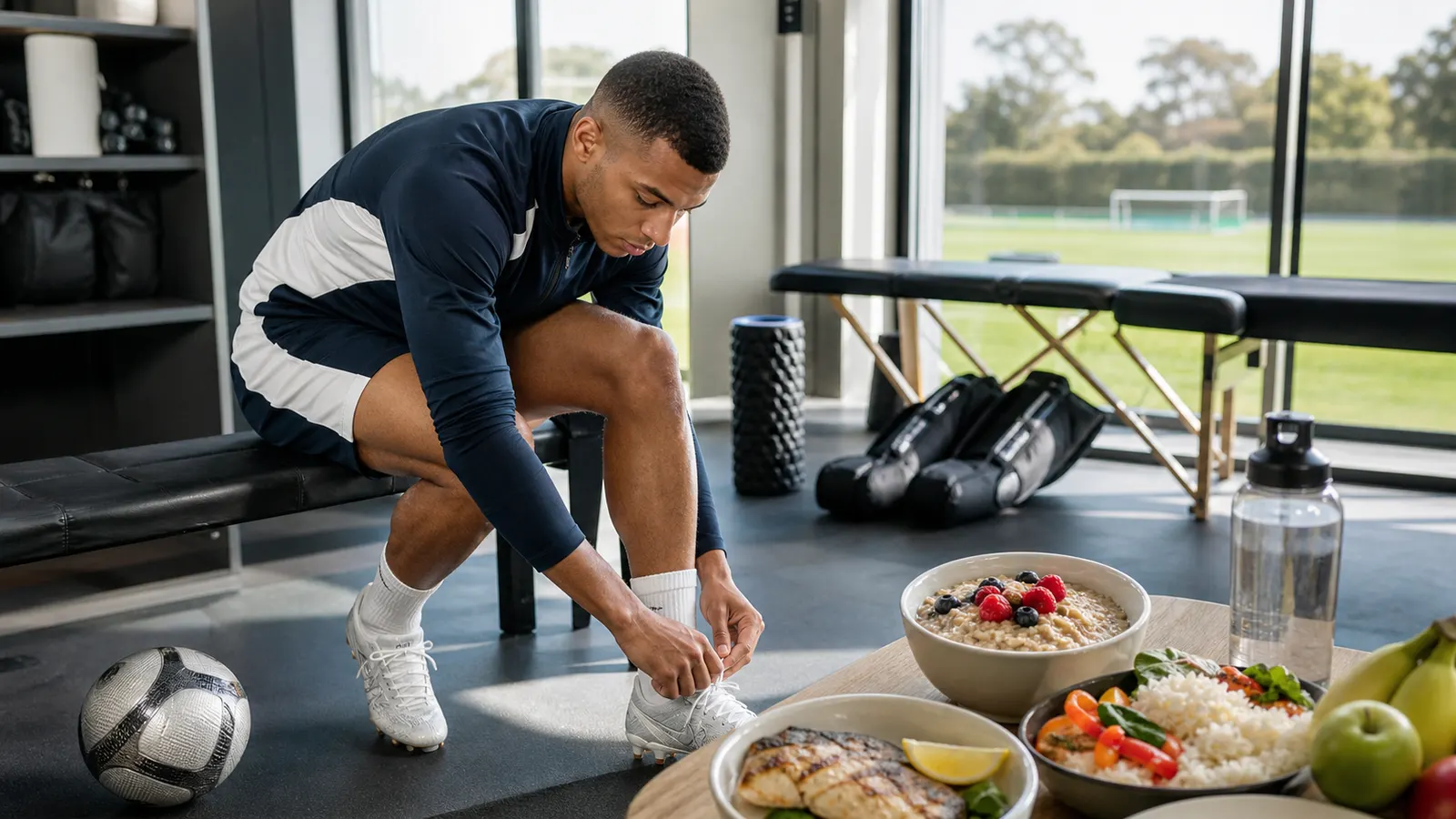
Quick fan read. Mbappé's routine is about speed, repeatability, and control. His game is built on explosive first steps, long runs into space, sharp finishing, and the pressure of being the face of France and a Real Madrid superstar. The habits around him are not mystical: eat enough to run fast again tomorrow, protect recovery, keep the body ready for repeated sprints, and keep enough calm around a very loud career.
His public food story is lighter than Ronaldo's or Haaland's, but a few useful pieces are clear. France's national-team food environment is performance-focused, Mbappé has talked about enjoying jamón in Spain, and GQ's 2024 profile gives the best direct recovery clues: more stretching before matches, more physio afterward, extra work at the training center, and home as a mental reset space123.
Read this as a football fan's guide. Pro routines shift with matches, travel, injuries, and tournament life, but Mbappé's habits still teach a clear lesson about elite forward life: speed needs fuel, calm, and recovery.
Mbappé's route: Bondy, Clairefontaine, Monaco, PSG, Madrid
Mbappé's routine makes more sense when you see the path that created the performance demands.
Real Madrid's official profile lists him as a forward, born in Paris, 75 kg and 1.78 m, with career entries for Monaco from 2013-2017, PSG from 2017-2024, and Real Madrid from 2024 onward4. Real Madrid announced on June 3, 2024 that the club and Mbappé had reached a five-season agreement5.
The earlier route is just as important. The Guardian described him as registered as a player in Bondy from age six, then joining Clairefontaine around age 12, before becoming the teenage Monaco forward whose 2016-17 Champions League performances made all of Europe pay attention6. That same Guardian feature frames the move to Madrid as the next stage of a long-managed career plan, not a random late-career transfer6.
The timeline is clean:
| Stage | Why it matters |
|---|---|
| Bondy | Early football base, family influence, and first structured development |
| Clairefontaine | Elite French development environment before the senior spotlight |
| Monaco | Teenage breakout, first major Champions League attention, and proof of top-level speed |
| PSG | Star years, enormous scoring load, French domestic dominance, and global profile |
| France | World Cup pressure, captaincy, travel, and the burden of being the face of a generation |
| Real Madrid | A new tactical, commercial, and performance environment in Spain |
For a routine article, the key is not just fame. Mbappé is a forward whose game asks for acceleration, repeated high-speed runs, sharp deceleration, finishing, and recovery between matches. GQ noted in January 2024 that he had already played more than 400 games at the summit of men's soccer by age 25, which is the workload behind the routine conversation3. A classic Sports Medicine review describes soccer as a 90-minute endurance context layered with explosive bursts: sprinting, turning, changing pace, kicking, jumping, and contact actions7. That is the physical demand his food, sleep, morning structure, and recovery habits have to support.
Diet: fast-forward fuel
Mbappé is not famous for publishing a strict celebrity meal plan. That is fine, because the football logic is still clear.
A 75 kg elite forward needs food that supports repeated acceleration, sprinting, deceleration, finishing, and recovery. France's national-team kitchen is reported to monitor player intake and build performance-focused menus during tournaments, and Mbappé's most human food detail is wonderfully simple: he has said he likes jamón since arriving in Spain12.
The fan-friendly version:
| Diet piece | What it means for his routine |
|---|---|
| Carbs around training | Rice, potatoes, pasta, fruit, bread, or cereal help fuel repeated sprints |
| Protein through the day | Fish, chicken, eggs, yogurt, dairy, or lean meat support repair |
| Team food environment | Tournament meals are not random; they are built around performance |
| Jamón in Spain | Favorite foods can fit without becoming the whole plan |
| Hydration | A fast player needs fluid habits that survive training, travel, and heat |
That food picture is less flashy than a viral "secret diet" post, but it is more useful for fans who actually play, train, or just want to understand the sport better.
Diet principles: the useful version
Because this site already has a full Mbappé diet breakdown, this article keeps the diet section shorter and tied to routine.
Think of this as a footballer-style structure scaled to Mbappé's role and body size. Nutrition values in the linked diet article are rounded estimates using USDA FoodData Central and common label values, so exact numbers vary by brand, portion, and cooking method8.
The useful daily structure is:
| Routine moment | What the food needs to do | Practical examples |
|---|---|---|
| Breakfast | Start hydration, carbohydrate availability, and protein distribution | Oats, fruit, yogurt or milk, eggs, toast |
| Pre- or post-training snack | Add digestible fuel and recovery support | Fruit, yogurt, honey, cereal, sandwich, smoothie |
| Lunch | Refill energy without making the day too heavy | Rice or potatoes, chicken or fish, vegetables, olive oil |
| Preference food | Keep favorite foods in context | A small jamón portion with bread and fruit, not the whole diet |
| Dinner | Restore glycogen and support tissue repair | Pasta or potatoes with fish, chicken, lean beef, vegetables |
The useful principles are:
- Carbohydrates are present at every major meal because football is high-intensity and intermittent.
- Protein is spread across the day instead of saved for dinner.
- Jamón is included as a small preference/context food, not treated as the foundation of performance.
- The menu can move up or down with the day: more rice, pasta, bread, potatoes, cereal, and sports drinks around matches; less starch on light recovery days.
- The chef story supports the idea of monitored intake, but it does not reveal Mbappé's private plate.
For calories and macros, use the dedicated Mbappé diet article. It models a normal training day at about 3,110 calories and frames a broader 3,000-3,500 calorie range for a 75 kg elite-forward training day, with lower or higher needs depending on workload.
Sleep protocol: keep the speed fresh
Mbappé has not laid out a full sleep checklist in public: bedtime, wake time, room temperature, naps, supplements, all of it. That does not make sleep a small topic. It makes the lesson simpler.
What we can do is build a safe, elite-forward sleep framework. CDC sleep guidance says adults need at least 7 hours of sleep, that sleep quality matters as well as quantity, and that better sleep habits include consistent bed and wake times, a quiet/cool bedroom, turning off electronics before bed, avoiding large meals and alcohol before bedtime, avoiding afternoon/evening caffeine, and exercising regularly9.
For Mbappé's context, a useful sleep routine looks like this:
| Sleep element | Why it matters |
|---|---|
| Enough total sleep | Speed and decision-making are harder to repeat when recovery is poor |
| Travel-proof habits | Club and national-team football are full of flights and hotels |
| Evening screen boundaries | Lower stimulation before bed |
| Caffeine timing | Keep late caffeine from stealing sleep quality |
| Cool, dark, quiet room | Simple setup beats complicated hacks |
| Medical help when needed | Snoring, gasping, or constant exhaustion are not normal training problems |
The most useful "Mbappé protocol" is therefore not a gadget stack. It is a performance rule: sleep is part of training because speed and decision-making are harder to repeat when recovery is poor.
Morning routine: build the day around speed
Mbappé's exact morning is private, but the job of the morning is easy to understand: get the body ready for fast football without wasting energy.
| Morning element | Why it belongs |
|---|---|
| Wake, hydrate, eat | A hard training day needs fluid, energy, and digestion time |
| Carbs plus protein | Supports training fuel and repair |
| Mobility and activation | Helps prepare repeated sprinting, cutting, and finishing |
| Club or national-team training | The day is built around staff-led football work |
| Training-center work | Mbappé has talked about doing required work at the training center, even if that means staying late3 |
| Calm around the work | His public wellness language emphasizes moving, recovering, breathing, and recentering10 |
That gives a practical, not pretend-private, version:
- Wake at a consistent time when the schedule allows.
- Hydrate before caffeine.
- Eat a digestible breakfast with carbs and protein.
- Use a short mobility and activation block before the main football work.
- Train with quality, not random extra volume.
- Refuel after training.
- Protect the evening so the next day starts from recovery, not fatigue.
The caveat is important: a match day, travel day, recovery day, and national-team tournament day will not look the same. Professional routines are flexible systems, not fixed influencer checklists.
For the training side, the dedicated Mbappé workout routine covers speed, strength, repeated sprint ability, and mobility without pretending to know his private gym plan.
Recovery: stretching, physio, mental space, and the boring basics
The clearest direct recovery reporting comes from GQ's 2024 profile. Mbappé discussed needing more stretching before matches, more time with physiotherapists afterward, doing work at the training center when possible, and treating home as a place to relax with family rather than another extension of work3.
That is more useful than a gadget list. It says recovery is physical, logistical, and mental.
Condé Nast Traveler added a broader, branded wellness frame in 2026. In that ambassador interview, Mbappé described well-being as larger than recovery alone: moving, recovering, breathing, recentering, and being able to care for yourself anywhere, including while traveling10.
That fits football better than a single recovery hack. Mbappé's job is not only to feel fresh at home. It is to handle club matches, France duty, flights, hotels, media, pressure, and short turnarounds.
The responsible recovery stack looks like this:
| Recovery layer | Why it matters | Reader version |
|---|---|---|
| Sleep | Highest-value recovery input | Set a consistent bedtime and screen boundary |
| Food | Restores energy and supports tissue repair | Eat enough total calories, carbs, and protein |
| Hydration | Supports performance and travel recovery | Use water and electrolytes when sweat/travel demands it |
| Load management | Prevents hard days from becoming every day | Alternate hard sessions with lighter days |
| Stretching and physiotherapy | Directly discussed in GQ | Warm up, cool down, and address pain early |
| Staged injury return | Highlighted by El País reporting in 2026 | Follow diagnosis and return-to-play steps instead of guessing |
| Breath or calm work | Downshifts stress | Use 5-10 minutes of quiet breathing, walking, or stretching |
| Optional services | Massage, physiotherapy, compression, spa tools | Helpful when appropriate, but not a substitute for the basics |
The phrase "wherever you are" matters. A normal reader may not have a club recovery room, but they can still build travel-proof habits: sleep mask, hydration plan, familiar breakfast, short mobility routine, and a post-training protein-and-carb meal.
El País also gives a useful warning against oversimplifying injuries. In March 2026, Mbappé said public claims about his knee injury had been inaccurate, emphasized getting the right diagnosis, and described returning step by step rather than skipping stages11. That is the safest recovery lesson in the whole piece: injuries are medical events, not content hooks.
What fans can take from it
Copy the structure, not the celebrity.
| Mbappé context | Safer reader version |
|---|---|
| Elite forward at 75 kg with high-speed demands | Match food to your own training, not his fame |
| France chef monitoring intake | Track enough to understand patterns, especially around hard days |
| Jamón preference in Spain | Keep favorite foods, but portion them deliberately |
| High-carb football demands | Do not fear carbs when you train hard |
| Protein distribution | Include protein at breakfast, lunch, dinner, and snacks if needed |
| Public recovery habits around stretching and physio | Warm up, cool down, and get professional help for persistent pain |
| Public wellness language around moving and recentering | Add a short mobility or breathing block you will actually do |
| Travel-heavy schedule | Build routines that work away from home |
| No public sleep protocol | Use evidence-based sleep hygiene instead of invented hacks |
If you are not training like a professional forward, you should not eat like one. But the logic transfers well: fuel the work, recover from the work, and make the routine simple enough to repeat.
Frequently asked questions
What is Kylian Mbappé's daily routine?
The public version is broad: wake, hydrate, eat a carbohydrate-and-protein breakfast, train with club or national-team staff, refuel, recover, manage travel/media demands, and protect sleep. The details will change by match, travel, and tournament schedule.
What does Kylian Mbappé eat?
His exact daily menu is not reliably published. Public reporting supports two limited points: France's national-team chef monitors player intake and builds performance-focused menus, and Mbappé has publicly expressed that he likes jamón in Spain12. The rest should be described as Mbappé-inspired sports nutrition, not his exact diet.
How many calories does Mbappé eat per day?
No reliable source publishes his daily calorie target. The dedicated Mindful diet model uses about 3,110 calories as an illustrative training day and frames a broad 3,000-3,500 calorie range for a 75 kg elite forward. That is not a measurement of Mbappé's intake. Real needs would change with matches, training load, travel, body-composition goals, and medical staff guidance.
What is Mbappé's sleep protocol?
There is no verified public Mbappé sleep protocol. The best reader version is evidence-based: consistent sleep timing when possible, at least 7 hours for adults, a cool and quiet room, electronics off before bed, caffeine earlier in the day, and medical help if sleep problems persist9.
What does Mbappé do for recovery?
Specific private modalities are not fully public. The strongest direct reporting points to stretching, physiotherapy, training-center work, and home as a mental reset space3. His broader wellness language adds movement, recovery, breathing, and recentering, especially while traveling10. For readers, the hierarchy is sleep, enough food, hydration, sensible training load, mobility, and optional recovery tools.
Should regular people copy Mbappé's routine?
No. Copy the principles, not the workload or portions. A desk-based adult, recreational runner, youth player, and elite Real Madrid forward all need different calories, training loads, and recovery plans.
Where Mindful fits
The useful part of Mbappé's routine story is not fantasy access. It is visibility.
If you train, play football, lift, run, or simply want steadier energy, Mindful can help you see whether your meals match the day you are asking your body to handle: protein, carbs, calories, hydration patterns, and the difference between hard-day hunger and casual grazing.
Use the athlete story as a prompt to build your own evidence-aware routine.
References
Footnotes
-
AS. "Xavier Rousseau, el chef de Francia que cuida la dieta de Mbappé: 'La idea es crear una cocina inteligente'." Updated June 22, 2026. Secondary reporting on France chef Xavier Rousseau, his work with the national team, and calorie monitoring. Source ↩ ↩2 ↩3
-
AS / Tikitakas. "La sincera opinión de Kylian Mbappé sobre el plato más típico en España: 'Intento buscar los mejores sitios'." September 22, 2025. Secondary reporting on Mbappé's comments about jamón in an Ibai Llanos video. Source ↩ ↩2 ↩3
-
GQ. "Kylian Mbappé on Leading France and Life After Messi and Neymar." January 17, 2024. Used for direct recovery and workload context, including stretching, physiotherapy, training-center work, home as mental recovery space, and fixture-load concerns. Source ↩ ↩2 ↩3 ↩4 ↩5
-
Real Madrid C.F. "Mbappé." Official player profile listing Kylian Mbappé as a forward, 75 kg, 1.78 m, and with career entries for Monaco, PSG, and Real Madrid. Source ↩
-
Real Madrid C.F. "Official Announcement: Mbappé." June 3, 2024. Real Madrid announced a five-season agreement with Kylian Mbappé. Source ↩
-
The Guardian. "Project Mbappé: can a summer with France make forward smile again?" June 8, 2024. Used for Bondy, Clairefontaine, Monaco breakout context, PSG years, and the Madrid career arc. Source ↩ ↩2
-
Stølen T, Chamari K, Castagna C, Wisløff U. "Physiology of Soccer: An Update." Sports Medicine 35:501-536. 2005. DOI ↩
-
USDA. FoodData Central. Nutrition database used as a baseline for rounded food estimates. Source ↩
-
Centers for Disease Control and Prevention. "About Sleep." Updated May 15, 2024. Used for adult sleep duration and sleep-habit guidance. Source ↩ ↩2
-
Condé Nast Traveler. "Kylian Mbappé Is Fairmont's First Wellness Ambassador." April 15, 2026. Used as branded wellness-interview context for Mbappé's public language around moving, recovering, breathing, recentering, and travel. Source ↩ ↩2 ↩3
-
El País. "Kylian Mbappé: 'Se han dicho cosas sobre mi lesión que no son verdad'." March 23, 2026. Used for Mbappé's comments on diagnosis, false injury claims, and returning step by step. Source ↩