Cutting vs. Bulking: A Beginner's Guide to Body Recomposition
Should you cut, bulk, or recomp? A research-backed guide to when to choose each phase, how to set calories and macros, and how beginners should think about body recomposition.
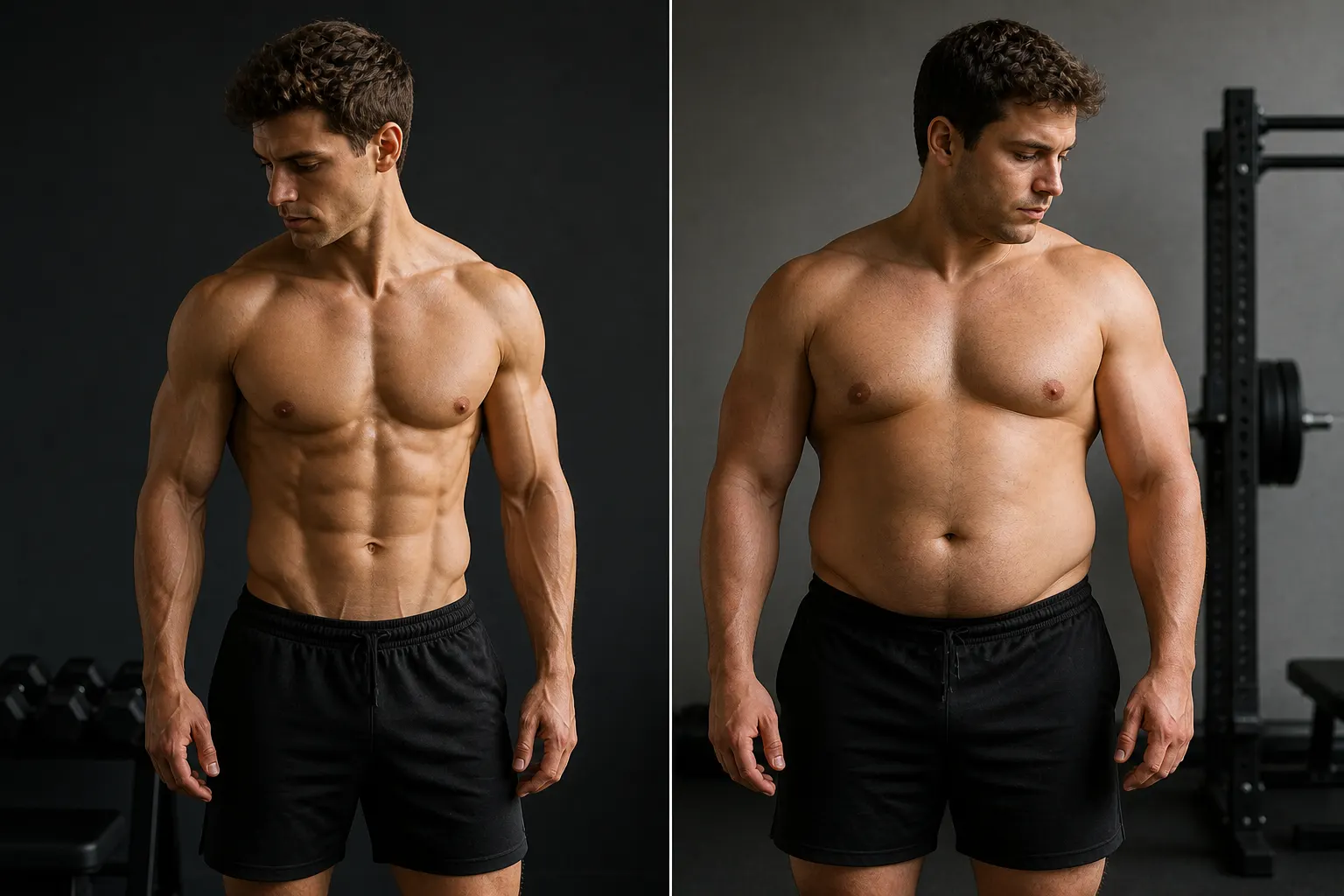
TL;DR. Cutting and bulking are the two opposing phases of structured body composition work. Cutting is a calorie deficit (typically 250-500 kcal/day below maintenance) designed to lose fat while preserving as much muscle as possible, driven mostly by adequate protein (1.6-2.2 g/kg body weight, or up to 2.3-3.1 g/kg of lean body mass for already-lean lifters) and consistent resistance training. Bulking is a calorie surplus (typically 200-500 kcal/day above maintenance) designed to build muscle, with the same protein targets and a focus on progressive overload in the gym. For many beginners and detrained returners, body recomposition, gaining muscle and losing fat simultaneously at maintenance calories, is achievable and often the better starting point. Below: when to choose each approach, how to set your numbers, the most common mistakes, and what the actual research says.
If you've started training and are now Googling "cutting vs bulking," you've probably already absorbed the basic gym-floor framing: eat in a surplus to build muscle, eat in a deficit to lose fat, and accept that you'll always be doing one or the other. That framing is partially right and partially outdated.
The actual evidence-based picture is more nuanced and more useful. The choice between cutting, bulking, or recomposition depends on three things: your current body fat level, your training experience, and your specific goals. The optimal answer is different for each combination. This guide walks through the actual numbers, the research behind them, and how to choose the right approach for where you are right now.
A note before reading. This article is for people who have decided to pursue structured body composition work and are training (or starting to train) with resistance. If you don't have a training routine yet, the calorie phase you're in matters far less than getting consistent in the gym. Build the training habit first; the bulk vs. cut question is downstream of that. Also: if you have a history of disordered eating, the rigid macro-tracking that bulking and cutting often involve can be a trigger. Body composition work isn't appropriate for everyone.
What cutting and bulking actually are
The two phases are built around opposite calorie-balance states.
Cutting is a sustained calorie deficit specifically structured to lose body fat while preserving muscle mass. It's not the same as general weight loss. The goal isn't just to get smaller, it's to get leaner (a lower percentage of body fat with the same or similar muscle mass). The mechanisms that distinguish a "cut" from a generic diet are high protein intake, continued resistance training to send muscle-preservation signals, and a moderate (not aggressive) deficit.
Bulking is a sustained calorie surplus specifically structured to build muscle mass. The premise: muscle protein synthesis is more efficient when energy availability is high, and resistance training during a surplus produces faster strength and hypertrophy gains. The trade-off is unavoidable: in a calorie surplus, some weight gain comes from fat, not muscle.
Body recomposition is the third option, operating at or near maintenance calories while training and eating high protein, with the goal of gaining muscle and losing fat simultaneously. This is often dismissed as impossible by traditional bodybuilding wisdom ("you can't gain muscle in a deficit"), but the research actually supports it under specific conditions, which we'll cover below.
When to cut, when to bulk, when to recomp
The right starting phase depends almost entirely on your current body fat level and training experience.
Use the body fat tier system
A reasonable framework, drawn from physique sport coaching practice and consistent with the body composition literature, looks like this. These are practical ranges, not medical cutoffs12:
For men:
- Above ~20% body fat: Cut first
- 15-20% body fat: Cut or recomp; recomp is more accessible at the lower end of this range
- 10-15% body fat: Recomp or lean bulk; cut only if heading into a specific event
- Below 10% body fat: Lean bulk; cutting further is hard to sustain and unhealthy long-term
For women:
- Above ~28% body fat: Cut first
- 22-28% body fat: Cut or recomp
- 18-22% body fat: Recomp or lean bulk
- Below 18% body fat: Lean bulk; women generally shouldn't sustain very low body fat for long periods due to hormonal effects (RED-S risks)
The logic: your body's ability to build muscle is shaped by training status, energy availability, recovery, and current body composition. Trying to bulk at high body fat often means a larger share of weight gain is fat. Trying to cut at very low body fat is harder to sustain and increases muscle-loss risk. The middle ranges have the most flexibility.
The training-experience axis matters too
Beginners and people returning to training after an extended break ("detrained") have a meaningful biological advantage that experienced lifters don't share. Untrained or detrained muscle responds to a resistance training stimulus with a much more pronounced adaptive response, sometimes called "newbie gains", because the muscle is far from its genetic ceiling and any reasonable stimulus produces fast adaptations3.
This is why body recomposition is most accessible for beginners and detrained returners, and most accessible for people at moderate or higher body fat (who have stored energy available to fuel muscle protein synthesis even while eating slightly below maintenance).
If you're a beginner with body fat above 15-18% (men) or 25-28% (women), recomp is almost certainly your best starting point. You don't need to choose between fat loss and muscle gain. You can pursue both simultaneously for the first 6-12 months of consistent training.
For experienced lifters near their genetic ceiling, the bulk/cut binary is more applicable. Recomp at that stage produces glacial progress on both fronts, and dedicated phases tend to produce better results.
How to actually cut: setting up the deficit
A well-designed cut has four moving parts: deficit size, protein intake, fat intake, and training.
Deficit size
The evidence-based recommendation for cutting while preserving muscle is to lose 0.5-1% of body weight per week4. This is more conservative than the general weight-loss guideline of 1-2 lbs per week, because the goal is muscle preservation, not just weight reduction.
For someone weighing 200 lbs, 0.5-1% per week is 1-2 lbs per week, same upper end as general weight loss, but the lower end (1 lb/week) is the target. For someone weighing 150 lbs, 0.5-1% is 0.75-1.5 lbs per week.
The corresponding calorie deficit:
- Modest cut (0.5% per week): about 250-300 kcal/day below maintenance
- Standard cut (0.75% per week): about 400-500 kcal/day below maintenance
- Aggressive cut (1% per week): about 500-700 kcal/day below maintenance
The ISSN's position stand on diets and body composition recommends that the deeper a cut goes (lower body fat, more aggressive deficit), the higher the protein intake should be to protect muscle2. Translation: if you're going for a more aggressive deficit, you need to be more careful about protein.
Protein during a cut
Protein intake is the single most important variable for muscle preservation during a cut. The research-backed targets:
- General target: 1.6-2.2 g/kg of body weight per day5
- For lean individuals (under 15% body fat for men, under 22% for women) cutting aggressively: 2.3-3.1 g/kg of lean body mass per day4
The "lean body mass" version is more relevant once you're already lean, body weight underestimates protein need at lower body fat percentages because more of your weight is metabolically active tissue.
For most beginners cutting, 0.8-1.0 grams of protein per pound of body weight is a clean practical target. For someone weighing 180 lbs, that's 144-180 grams of protein per day.
Fat during a cut
Don't cut fat too low. The fat floor for healthy hormone production is roughly 0.6-0.8 g/kg of body weight per day, or 20% of total calories, whichever is higher4. For someone weighing 180 lbs (82 kg) eating 2,200 calories per day, that's about 50-65g of fat as a floor.
Going below this floor for sustained periods has documented negative effects on testosterone, menstrual function, and overall hormonal health. This is the most common mistake in self-directed cuts: people cut fat to "make room" for protein and carbs, and end up below their hormonal floor.
Training during a cut
The single most important thing: keep lifting heavy with intent. The deficit alone is what produces fat loss; resistance training is what tells your body to preserve muscle while doing it. Drop your training volume or intensity during a cut, and you'll lose more muscle alongside the fat.
A reasonable cut training plan: 3-4 resistance training sessions per week focused on compound lifts (squat, deadlift, bench press, overhead press, rows, pull-ups), with the same weights and rep ranges you were using before the cut. Cardio can be added for additional calorie burn but isn't required.
How to actually bulk: setting up the surplus
A well-designed bulk also has four moving parts: surplus size, protein intake, training stimulus, and patience.
Surplus size: the case for "lean" bulking
The traditional bodybuilding wisdom of "eat big to get big", 500-1000 kcal surpluses or more, has been challenged by recent research. A 2023 randomized trial assigned resistance-trained individuals to maintenance calories, a ~5% surplus, or a ~15% surplus for 8 weeks while training. The larger surplus did not produce more muscle, it produced more skinfold thickness (a proxy for fat gain)6. The bigger surplus bought more fat, not more muscle.
A 2019 review in Frontiers in Nutrition concluded that the optimal surplus for muscle hypertrophy is unknown but is likely smaller than commonly recommended in bodybuilding literature, and that energy surpluses can be anabolic but aren't inherently "muscle-specific." Extra calories support tissue gain in general, not just muscle3.
The current evidence-based recommendation:
- Lean bulk (modest surplus): 200-300 kcal/day above maintenance, expecting 0.25-0.5% body weight gain per week
- Standard bulk: 300-500 kcal/day above maintenance, expecting 0.5-1% body weight gain per week
- Aggressive ("dirty") bulk: 500+ kcal/day above maintenance, expecting >1% body weight gain per week, generally not recommended; produces more fat than muscle
For most natural lifters (i.e., people not using performance-enhancing drugs), a modest surplus of 200-400 kcal/day is the sweet spot. This produces meaningful muscle gain over months while minimizing the fat gain that needs to be cut off later. The "lean bulk" approach, also called a "minibulk" or "controlled surplus", is the dominant evidence-based recommendation in current physique-sport literature.
Protein during a bulk
Same as cutting: 1.6-2.2 g/kg of body weight per day, or about 0.8-1.0 g per pound of body weight5. The 2018 British Journal of Sports Medicine meta-analysis that established the 1.6 g/kg threshold found no further gains in fat-free mass at intakes above this number, meaning the 4-grams-per-pound bro-science approach is not just unnecessary, it crowds out other macros without producing additional muscle.
Training during a bulk
The training stimulus is the cause of muscle growth; the surplus is just permission. Without a progressive resistance training stimulus, eating more calories produces fat gain, period.
A bulk training plan should emphasize:
- Progressive overload: Adding weight, reps, or sets to your major lifts over time
- Compound lifts: Squats, deadlifts, bench press, overhead press, rows, and pull-ups, which recruit the most muscle and produce the most adaptation
- Adequate volume: Most evidence supports higher weekly training volumes than one-set minimalist routines, often around 10+ weekly sets per major muscle group for hypertrophy-focused training7
- Sufficient frequency: Each muscle group trained 2-3 times per week
The food side of bulking is the easier half. The training side is where most bulks succeed or fail.
Patience
You will gain some fat during a bulk. This is not a failure; it's the math. Lean bulks produce roughly 2:1 muscle-to-fat ratio at best (i.e., for every 3 lbs gained, ~2 lbs is muscle and ~1 lb is fat). More aggressive bulks produce closer to 1:1 or worse.
Plan for the bulk to last 4-6 months minimum before evaluating progress. Muscle gain is slow, natural lifters typically gain 0.25-0.5 lbs of muscle per week at best, and only beginners hit the upper end of that range. Expecting to "see results" in three weeks is the fastest path to giving up too early.
Body recomposition: the often-overlooked third option
For a substantial portion of the training population, dedicated cut/bulk phases aren't the right starting point. Recomposition, eating at or near maintenance while training hard and consuming high protein, is the better choice for:
Beginners. Untrained muscle is far below its genetic ceiling. The combination of resistance training + adequate protein + moderate calorie balance produces simultaneous muscle gain and fat loss for the first 6-12 months of consistent training. This is the famous "newbie gains" period1.
People returning to training after a meaningful break. Muscle memory, both myonuclear and epigenetic, allows previously trained tissue to re-grow faster than untrained tissue, even at maintenance or in a slight deficit1.
Overweight or obese beginners. Higher body fat means more stored energy available to fuel muscle protein synthesis, even while eating slightly below maintenance. The combination produces meaningful fat loss alongside meaningful muscle gain1.
People who can't tolerate the psychological demands of bulking. Some people find dedicated bulks distressing: the visual fat gain, the constant eating, and the eventual cut required to reveal what was built. For these people, slow recomposition over 18-24 months is psychologically more sustainable than alternating bulks and cuts.
The recomposition approach:
- Calories: maintenance or slight deficit (50-200 kcal below maintenance)
- Protein: 1.6-2.2 g/kg body weight (the upper end of the range, protein matters more in recomp than in either pure cut or bulk)
- Training: structured progressive resistance training, 3-5 days per week
- Timeline: changes are slower than dedicated phases, expect months of stable scale weight while body composition shifts visibly
The scale will not move much during recomp. That's the point. Track progress through measurements (waist, hips, arms), photos, and how clothes fit, not through scale weight.
How long to spend in each phase
There's no universal answer, but evidence-based programming generally follows these durations.
Cuts: typically 12-16 weeks. Beyond that, metabolic adaptation accumulates significantly, and most people benefit from a planned diet break. For larger fat-loss goals (40+ lbs), structure the project as multiple cuts separated by 1-2 month maintenance periods, not one continuous deficit.
Bulks: typically 12-24 weeks. Lean bulks can run longer because the fat gain is slower; aggressive bulks should be cut shorter to limit how much fat needs to be removed afterward.
Recomp phases: typically 6-18 months as a primary approach for beginners, or as a maintenance phase between cut/bulk cycles for more experienced lifters.
A common annual structure for an experienced lifter aiming at long-term progress: two 4-month bulks separated by a 12-week cut, with a maintenance period before each transition. A common annual structure for a beginner: continuous recomp with occasional 2-week diet breaks at maintenance, no formal cut/bulk cycling for the first year of training.
The most common mistakes
Bulking when you should be cutting. Starting a bulk at body fat above 15-20% (men) or 25-28% (women) means most of the surplus calories go to fat, the bulk has to end early, and the subsequent cut has to remove more weight than the bulk added. Net progress: minimal. If you're above these body fat levels, cut first.
Cutting too aggressively. Deficits beyond 1% of body weight per week consistently produce more muscle loss and worse adherence than moderate deficits. The 4-week aggressive crash diet that loses 12 lbs is rarely better than the 16-week moderate cut that loses the same 12 lbs with substantially less muscle damage.
Eating too much fat or carbs at the expense of protein. This is the single most common cutting mistake. Most people undershoot protein by 30-50g per day without realizing it. Without enough protein, the cut becomes a generic weight-loss diet, fat and muscle come off, and the visual outcome is the "smaller, softer" version of yourself rather than the leaner version.
Treating bulking as license to eat anything. A 2,500-calorie surplus from pizza and ice cream produces meaningfully different body composition outcomes than a 2,500-calorie surplus from chicken, rice, and olive oil. The "dirty bulk" approach was never well-supported by research; it was an excuse. Lean bulking with whole foods is the evidence-based approach.
Cutting without resistance training. A calorie deficit alone produces fat loss and muscle loss. Resistance training during the deficit is what tells the body to keep the muscle. Cardio alone won't do this; you need to be lifting weights.
Ignoring the scale weight noise. Daily weight fluctuates 2-5 lbs from water, glycogen, sodium, and digestion. People who panic about a 2-lb scale increase three days into a bulk often quit before any actual progress could have happened. Track 7-day rolling averages, not daily numbers.
Trying to recomp as an experienced trained lifter. Recomp works best for beginners and detrained returners. If you've been training consistently for 3+ years and are at moderate body fat, dedicated cut/bulk cycles produce more meaningful progress than indefinite recomp.
Frequently asked questions
Should I cut or bulk first?
Start by assessing your current body fat level. Above ~20% (men) or ~28% (women), cut first. Bulking from a higher body fat starts the muscle-building project from a worse hormonal and visual position. Below those thresholds, the choice is more flexible: lean bulk if your priority is muscle gain, recomp if you're a beginner or want a sustainable middle path.
How much should I eat to cut?
Calculate your maintenance calories (TDEE), then subtract 250-500 kcal/day. For most adults, a sustainable cut puts you at 1,400-2,000 kcal/day for women and 1,700-2,500 kcal/day for men, depending on size and activity. The deficit aims at 0.5-1% body weight loss per week. (Our calorie & macro calculator gives you the exact number.)
How much should I eat to bulk?
Calculate maintenance, then add 200-400 kcal/day for a lean bulk. For most adults that's 2,200-3,000+ kcal/day, again depending on size and activity. The surplus aims at 0.25-0.5% body weight gain per week. Larger surpluses produce more fat than muscle and aren't recommended for natural lifters.
How long should a cut last?
12-16 weeks for most cuts. Beyond that, metabolic adaptation makes further progress harder, and a 1-2 week diet break at maintenance typically produces better long-term outcomes than continuing to push the deficit. For larger fat-loss goals (>20 lbs), structure as multiple shorter cuts with maintenance breaks between them.
How long should a bulk last?
12-24 weeks. Lean bulks can run longer than aggressive ones. Track your weekly weight gain; if it exceeds 0.5-1% of body weight per week, you're gaining too fast and likely accumulating more fat than muscle.
Can I build muscle and lose fat at the same time?
Yes, under specific conditions: you're a beginner or returning to training after a break, you're at moderate or higher body fat, your protein intake is adequate (1.6-2.2 g/kg), and you're training hard with resistance exercise. This is body recomposition. For experienced lifters near their genetic ceiling, simultaneous gain and loss happen at glacial rates and dedicated cut/bulk phases produce faster progress.
How much protein do I need to cut?
1.6-2.2 grams per kilogram of body weight per day for most lifters; 2.3-3.1 g/kg of lean body mass for already-lean individuals cutting aggressively. In practical terms, around 0.8-1.0 grams of protein per pound of body weight is a clean target for most cutters.
What's the difference between cutting and just losing weight?
Cutting is structured weight loss specifically designed to preserve muscle. The differences from generic weight loss: higher protein intake (most diet plans don't push protein this hard), continued resistance training (most diet plans focus on cardio or none), and a more moderate deficit (most diet plans push for faster scale movement). For more on macro-tracking specifically, see our guide to tracking macros.
Will I lose all my gains if I cut?
No, if you do it correctly. The combination of adequate protein (1.6-2.2 g/kg), consistent resistance training, and a moderate (not aggressive) deficit preserves the vast majority of muscle mass during a cut. Some muscle loss is normal, especially in cuts longer than 16 weeks, but well-executed cuts retain >90% of muscle mass while reducing fat by meaningful percentages.
Do I need to track macros to cut or bulk?
Strongly recommended, especially for the first cycle. Tracking surfaces the gap between what you think you're eating and what you're actually eating, and that gap is almost always larger than you'd expect. A tracker like Mindful is useful here because the point is not to make food feel clinical; it is to see whether calories, protein, and weekly weight trends match the phase you chose. Most beginners discover they were 200-400 calories off from their target, in either direction, and that gap is the difference between a bulk and a recomp, or between a sustainable cut and a stall.
Where Mindful can help
The useful part of tracking a cut, bulk, or recomp is not turning every meal into a scorecard. It is making the big levers visible: calories, protein, carbs, fat, weekly weight trends, and whether your phase is actually moving in the direction you intended.
Mindful can help with that because food logging, macro targets, and trend checks live in one place. For a cut, that means seeing whether protein is high enough while the deficit stays moderate. For a bulk, it means catching an oversized surplus before it turns into unnecessary fat gain. For recomp, it means watching the longer pattern instead of reacting to a scale that barely moves.
References
Footnotes
-
Barakat C, Pearson J, Escalante G, Campbell B, De Souza EO. "Body Recomposition: Can Trained Individuals Build Muscle and Lose Fat at the Same Time?" Strength & Conditioning Journal 42(5):7-21. October 2020. DOI ↩ ↩2 ↩3 ↩4
-
Aragon AA, Schoenfeld BJ, Wildman R, et al. "International society of sports nutrition position stand: diets and body composition." Journal of the International Society of Sports Nutrition 14:16. June 2017. DOI ↩ ↩2
-
Slater GJ, Dieter BP, Marsh DJ, Helms ER, Shaw G, Iraki J. "Is an Energy Surplus Required to Maximize Skeletal Muscle Hypertrophy Associated With Resistance Training?" Frontiers in Nutrition 6:131. August 2019. DOI ↩ ↩2
-
Helms ER, Aragon AA, Fitschen PJ. "Evidence-based recommendations for natural bodybuilding contest preparation: nutrition and supplementation." Journal of the International Society of Sports Nutrition 11:20. May 2014. DOI ↩ ↩2 ↩3
-
Morton RW, Murphy KT, McKellar SR, Schoenfeld BJ, Henselmans M, Helms E, Aragon AA, Devries MC, Banfield L, Krieger JW, Phillips SM. "A systematic review, meta-analysis and meta-regression of the effect of protein supplementation on resistance training-induced gains in muscle mass and strength in healthy adults." British Journal of Sports Medicine 52(6):376-384. March 2018. DOI ↩ ↩2
-
Helms ER, Spence AJ, Sousa C, Kreiger J, Taylor S, Oranchuk DJ, Dieter BP, Watkins CM. "Effect of Small and Large Energy Surpluses on Strength, Muscle, and Skinfold Thickness in Resistance-Trained Individuals: A Parallel Groups Design." Sports Medicine - Open 9(1):102. November 2023. DOI ↩
-
Schoenfeld BJ, Ogborn D, Krieger JW. "Dose-response relationship between weekly resistance training volume and increases in muscle mass: A systematic review and meta-analysis." Journal of Sports Sciences 35(11):1073-1082. June 2017. DOI ↩