How to Read a Nutrition Label (and What Actually Matters)
A practical guide to the Nutrition Facts label: which lines actually matter, which are noise, what front-of-package claims mean, and how to read a label in 10 seconds.
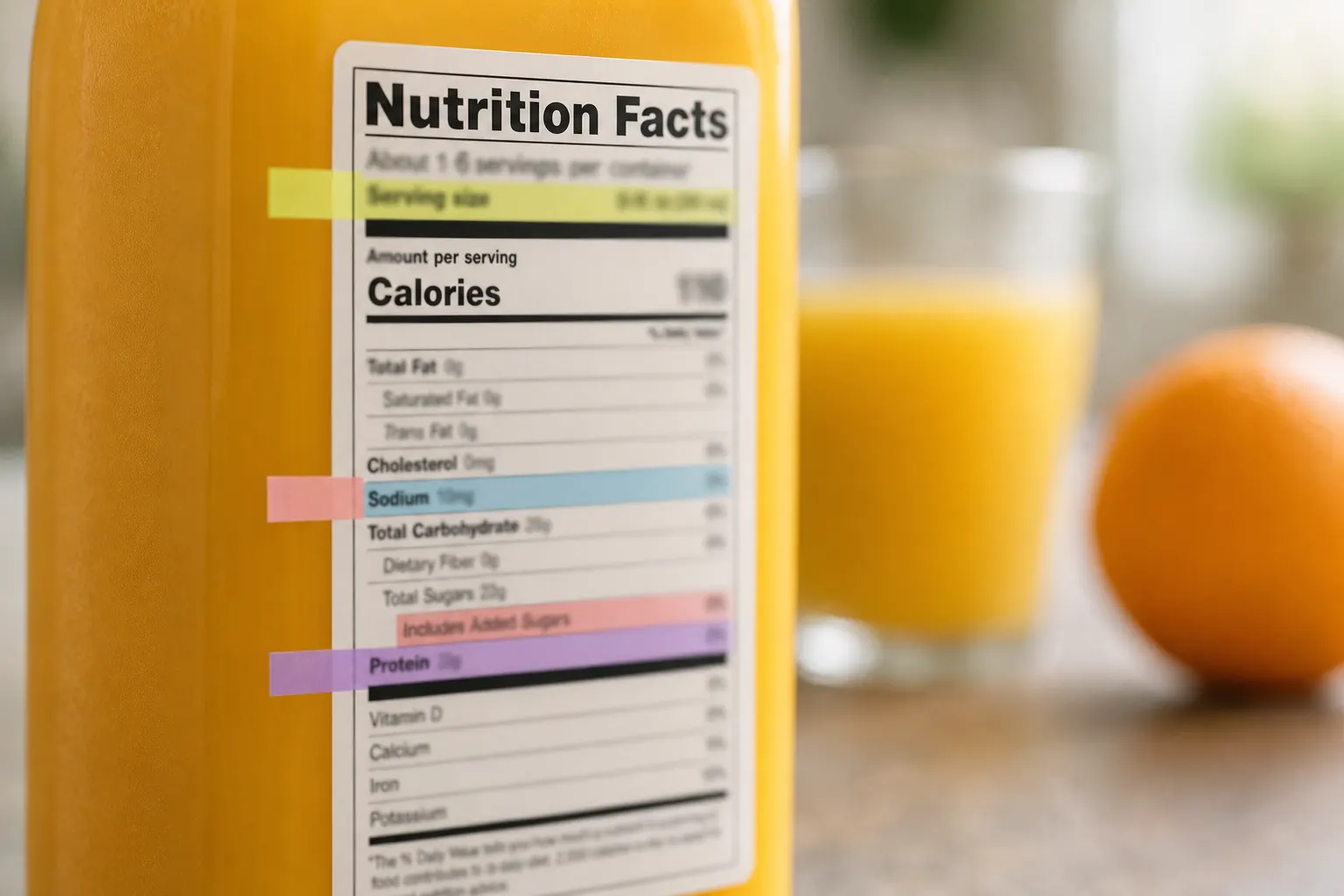
TL;DR. The Nutrition Facts label has a lot of lines, but most everyday decisions come down to five: serving size, calories, protein, added sugars, and sodium. Serving size is the biggest trap. Calories tell you the energy cost. Protein helps you judge satiety and macro value. Added sugars show what used to be hidden inside total sugars. Sodium matters most for blood pressure and packaged-food awareness. Lines like total fat, cholesterol, and % Daily Value can matter in specific contexts, but they are less useful than most people think. The ingredients list often tells you more about food quality than the Nutrition Facts panel itself.
The Nutrition Facts label is one of the most common public-health tools in daily life. It is also one of the least intuitive. Most explainers walk through every line in order, as if each one matters equally. In practice, a few lines carry most of the useful information, and the rest depends heavily on your goal.
This guide gives you the practical version: what matters, what is mostly noise, what front-of-package claims mean, and how to read a label in about 10 seconds without turning grocery shopping into homework.
A note before reading. Detailed label reading is useful for some people: anyone managing a health condition, working toward a calorie target, trying to increase protein, or watching added sugar or sodium. It can be unhelpful for people with a history of disordered eating or anyone who notices food anxiety increasing when labels become the focus. If labels make food feel more stressful, a less structured approach is probably a better fit.
A quick anatomy of the label
The current U.S. Nutrition Facts label reflects FDA updates finalized in 2016. Those updates made calories and serving sizes more prominent, added the Added Sugars line, updated Daily Values, and changed which vitamins and minerals must be listed1.
From top to bottom, the panel usually includes:
- Serving size and servings per container
- Calories per serving
- Total fat, with saturated fat and trans fat below
- Cholesterol
- Sodium
- Total carbohydrate, with dietary fiber, total sugars, and added sugars below
- Protein
- Vitamin D, calcium, iron, and potassium
- % Daily Value down the right side
That last column is important context. The % Daily Value is based on a 2,000-calorie reference diet. If you eat meaningfully more or less than that, the percentages are still useful as rough signals, but they are not personalized.
What actually matters
These five lines carry most of the useful information for everyday decisions.
1. Serving size
Serving size is the line people miss most often, and it creates the biggest mistakes.
A cereal label might list 130 calories, but the serving size may be 3/4 cup. If your normal bowl is 1.5 cups, you ate two servings. A bottle of juice might list calories per 8 fl oz, while the bottle contains 16 fl oz. A chip bag might look like one serving but list three servings per container.
The fix: read serving size before every other number. Compare the serving size to what you will actually eat or drink. If you will eat the whole package, multiply the label by the servings per container.
2. Calories
Calories matter, but only after serving size. They tell you the energy cost of the food, not whether the food is "good" or "bad."
The better question is: does this calorie cost match what the food gives back? A 200-calorie Greek yogurt and a 200-calorie candy are the same energy number, but they usually have very different effects on fullness, protein intake, and later hunger.
For weight loss, label calories are most useful when compared with your daily target. A 600-calorie packaged meal is a major part of a 1,600-calorie day. A 200-calorie snack is smaller. The percentage of your day often matters more than the number by itself.
3. Protein
For weight loss and body composition, protein is one of the most useful lines on the label. It is the macro many adults undershoot, and it helps with satiety and lean-mass preservation during weight loss.
A practical rule: less than 5 g of protein per 100 calories is not a meaningful protein source. That does not mean you cannot eat it. It just means you should not count it as doing much work toward your protein target.
A "protein" snack with 8 g of protein and 240 calories is mostly a snack with a little protein added. A Greek yogurt with 17 g of protein and 100 calories is a true protein source.
4. Added sugars
Added sugars are one of the most useful additions to the modern label. Older labels listed only total sugars, which mixed naturally occurring sugars in fruit and dairy with sugars added during processing. The current label separates them.
The Dietary Guidelines for Americans recommend limiting added sugars to less than 10% of calories2. On a 2,000-calorie diet, that is 50 g per day. The World Health Organization recommends reducing free sugars below 10% of energy intake, with a further reduction below 5% for additional health benefits3.
A practical threshold: more than 10 g of added sugar per serving is a meaningful sugar source. This shows up in places people do not always expect: flavored yogurt, granola, breakfast cereal, sauces, dressings, bars, juice drinks, and sweetened coffee beverages.
5. Sodium
Sodium matters most for people with high blood pressure, kidney concerns, cardiovascular risk, or a family history of hypertension. It is also useful because packaged and restaurant foods are where most sodium enters the diet.
The FDA Daily Value for sodium is 2,300 mg/day4. A practical label-reading threshold is:
- 140 mg or less per serving is considered low sodium by FDA definitions5
- 400 mg or more per serving is worth noticing
- 800 mg or more per serving is high enough that the rest of the day should probably be lower sodium
Common surprises include bread, cottage cheese, deli meat, canned soup, frozen meals, sauces, cheese, and restaurant-style packaged foods.
What is mostly noise
These lines get more attention than they usually deserve.
Total fat
Total fat does not tell you much by itself. Fat from olive oil, nuts, avocado, and salmon is not the same as fat from packaged pastries. Current guidance is more concerned with fat type than total fat.
The practical version: look at saturated fat if you are thinking about cardiovascular health. Keep trans fat at 0 g. Do not treat total fat as a quality score.
Cholesterol
The 300 mg/day cholesterol limit was removed from the 2015-2020 Dietary Guidelines for Americans because dietary cholesterol was no longer considered a nutrient of concern for overconsumption in the same way2. Blood cholesterol is influenced more strongly by saturated fat, overall diet quality, genetics, and body weight than by dietary cholesterol alone for most people.
The cholesterol line still appears on the label, but for most adults it is not a top-five line. If your clinician told you to monitor dietary cholesterol, follow that advice. Otherwise, saturated fat and overall diet quality usually matter more.
% Daily Value
The %DV column looks precise, but it is best used as a rough guide. The FDA's quick rule is simple: 5% DV or less is low; 20% DV or more is high6.
The problem is that the percentages are based on a 2,000-calorie reference diet. If your actual intake is 1,500 or 2,500 calories, the percentages are not personalized. Some Daily Values are useful ceilings, like sodium and added sugar. Others are minimums, like vitamins and minerals. Treat %DV as orientation, not a verdict.
Vitamins and minerals
The label requires vitamin D, calcium, iron, and potassium because those are nutrients many Americans do not get enough of1. That is useful information, but most packaged foods provide small amounts.
If you are managing a specific nutrient concern, use a dedicated tracker or clinician guidance. For everyday grocery decisions, vitamins and minerals are usually less important than serving size, calories, protein, added sugar, sodium, and the ingredients list.
What front-of-package claims mean
The Nutrition Facts panel is regulated. The front of the package is where marketing does more work.
"Natural." FDA has not formally defined "natural" for most foods. The agency has a longstanding informal policy that natural means nothing artificial or synthetic has been added that would not normally be expected, but the term remains much less useful than people assume7.
"Light" or "lite." This is regulated. In many contexts, it means the food has one-third fewer calories or 50% less fat than a reference food, though the exact comparison matters5.
"Low fat" and "fat free." These are regulated nutrient-content claims. "Low fat" means 3 g or less of fat per serving. "Fat free" means less than 0.5 g per serving5. The catch is that low-fat versions sometimes add sugar or starch to improve taste.
"Whole grain" or "made with whole grains." This can be technically true even when the product is mostly refined flour. The ingredients list matters more than the front claim. Look for "whole wheat flour" or "whole grain [grain name]" as the first grain ingredient.
"Sugar free." This means less than 0.5 g of sugar per serving5. It often means artificial or non-nutritive sweeteners are used instead. Whether that is useful depends on your goals and tolerance.
"No added sugar." This means sugar was not added during processing, but the food can still contain naturally occurring sugar. Plain milk, dried fruit, and fruit juice can all contain sugar without added sugar.
"Low carb" or "keto." These claims are not standardized in the same way as low sodium or low fat. Check total carbohydrate, fiber, added sugars, and serving size instead of relying on the front label.
"Healthy." FDA finalized an updated "healthy" claim rule in December 2024. It focuses on food group equivalents and limits for added sugars, saturated fat, and sodium, with compliance required in 20288. This is more useful than the old framework, but it still does not replace reading the label.
"Organic." USDA organic tells you about production methods. It does not automatically mean the food is lower in calories, sugar, or sodium. An organic cookie is still a cookie.
The ingredients list matters
The Nutrition Facts panel tells you numbers. The ingredients list tells you what the food actually is.
Three rules help:
Ingredients are listed by weight. The first ingredient is the largest by weight, the second is the next largest, and so on. If sugar is first or second, that tells you a lot.
Sugar has many names. Cane sugar, brown rice syrup, agave, fruit juice concentrate, dextrose, fructose, glucose, maltose, sucrose, high-fructose corn syrup, malt syrup, and molasses are all forms of added sugar. The Added Sugars line is often easier than decoding every name.
The first three ingredients carry most of the signal. If the front says whole grain but the first ingredient is enriched flour, it is mostly refined flour. If a fruit snack lists sugar and juice concentrate before fruit puree, the front-of-package fruit imagery is doing more work than the fruit.
This is not about avoiding every processed food. It is about knowing whether the front of the package matches what is actually inside.
How to read a label in 10 seconds
The full version of label reading is detailed. The practical version is fast:
- Check serving size and servings per container.
- Check calories against what you are trying to do.
- Check protein, added sugars, and sodium in that order.
- Scan the first three ingredients if the package is making a health claim.
That captures most of the value. Saturated fat, fiber, vitamins, and minerals can matter in specific contexts, but the four-step workflow above is enough for most packaged-food decisions.
When labels mislead
Even accurate labels can still mislead in practice.
Multi-serving packages. A package can look like one serving but contain two or three. Always check servings per container.
Rounding rules. FDA rules allow small amounts to round down. Less than 0.5 g of fat can appear as 0 g fat, and less than 5 calories can appear as 0 calories. This matters most for foods people use in large amounts while treating them as "free," like cooking sprays or very low-calorie condiments.
Restaurant food. Chain restaurants with 20 or more locations are required to provide calorie information on menus and menu boards in the U.S.9. Independent restaurants are not covered by that rule, and full nutrition information is often harder to find.
Dietary supplements. Supplements use Supplement Facts panels and are regulated differently from foods. Treat supplement labels separately and skeptically.
Portion size in real life. The label may be accurate per serving, but your portion may not match the serving. This is the most common source of error.
Frequently asked questions
What is the most important thing to look for on a nutrition label?
Serving size first. Then calories, protein, added sugars, and sodium. Those five lines cover most practical decisions.
What does % Daily Value mean?
It tells you how much a nutrient in one serving contributes to a 2,000-calorie reference diet. FDA's quick guide is that 5% DV or less is low and 20% DV or more is high6.
Are added sugars worse than natural sugars?
Chemically, the sugars are not magic different molecules. The practical difference is the package they come in. Whole fruit brings water, fiber, and micronutrients. Added sugar often comes in foods that are easy to overeat and less filling. That is why added sugars get their own line.
Why is cholesterol still on the label?
Because label rules and dietary guidance do not always update at the same speed. The 2015-2020 Dietary Guidelines removed the old 300 mg/day limit from the main guidance, but cholesterol remains listed on the Nutrition Facts label2.
Are foods labeled natural actually natural?
Not in a very useful sense. FDA has not formally defined the term for most foods, so "natural" is usually marketing language rather than a reliable nutrition signal7.
What is the difference between sugar free and no added sugar?
Sugar free means less than 0.5 g of sugar per serving. No added sugar means no sugar was added during processing, but the food may still contain naturally occurring sugars.
Is made with whole grains the same as 100% whole grain?
No. Made with whole grains can mean a small amount of whole grain. Check the ingredients list. The first grain ingredient should say whole wheat flour or whole grain plus the grain name.
Should I trust heart healthy on packaging?
Generic heart healthy language is usually marketing. A formal certification mark has criteria behind it, but the Nutrition Facts panel still matters more than the phrase on the front.
How do I know if a packaged food is too processed?
There is no single Nutrition Facts line for processing. The ingredients list is the best quick proxy. Shorter lists of recognizable foods usually mean less processing, though this is a heuristic, not a law.
Should I track calories from labels exactly?
Treat label values as useful estimates, not perfect measurements. Rounding rules, manufacturing variation, and real-world portion sizes all create error. Tracking is most useful for trend awareness, not daily precision.
Where Mindful fits
Reading labels well is a useful skill, but doing it manually for every packaged food gets tedious. Mindful's label scanning feature handles the data-entry part: take a photo of the Nutrition Facts panel and the app captures calories, protein, carbs, fat, and key nutrients into your log.
That shifts the work from typing numbers to deciding whether the food fits your goals. You can still verify the serving size, check added sugars or sodium, and edit the entry if needed, but you do not have to rebuild the label by hand.
If you want nutrition labels to be easier to use without making grocery shopping feel like a spreadsheet, label scanning is the practical place Mindful helps.
References
Footnotes
-
U.S. Food and Drug Administration. "Changes to the Nutrition Facts Label." FDA summary of the updated label, including serving size, calories, added sugars, and required micronutrient changes. Source ↩ ↩2
-
U.S. Department of Agriculture and U.S. Department of Health and Human Services. Dietary Guidelines for Americans, 2015-2020. The 2015 update removed the previous 300 mg/day cholesterol limit from the main dietary guidance. Source ↩ ↩2 ↩3
-
World Health Organization. "Guideline: Sugars intake for adults and children." 2015. Source ↩
-
U.S. Food and Drug Administration. "Daily Value on the Nutrition and Supplement Facts Labels." FDA lists the Daily Value for sodium as 2,300 mg/day and added sugars as 50 g/day. Source ↩
-
U.S. Food and Drug Administration. "Food Labeling Guide." FDA definitions for nutrient-content claims including low sodium, low fat, fat free, light, and sugar free. Source ↩ ↩2 ↩3 ↩4
-
U.S. Food and Drug Administration. "How to Understand and Use the Nutrition Facts Label." FDA quick guide for % Daily Value, including 5% DV as low and 20% DV as high. Source ↩ ↩2
-
U.S. Food and Drug Administration. "Use of the Term Natural on Food Labeling." FDA explains its longstanding policy and lack of a formal definition for most foods. Source ↩ ↩2
-
U.S. Food and Drug Administration. "Use of the 'Healthy' Claim on Food Labeling." Final rule issued December 2024, effective April 28, 2025, with compliance date February 25, 2028. Source ↩
-
U.S. Food and Drug Administration. "Menu Labeling Requirements." Chain restaurants and similar retail food establishments with 20 or more locations must provide calorie information. Source ↩