Famous 2026 World Cup Players, Favorite Foods, Calories, and Macros
A researched guide to famous 2026 World Cup players, their reported favorite or go-to foods, and realistic calories, protein, carbs, and fat for each food.
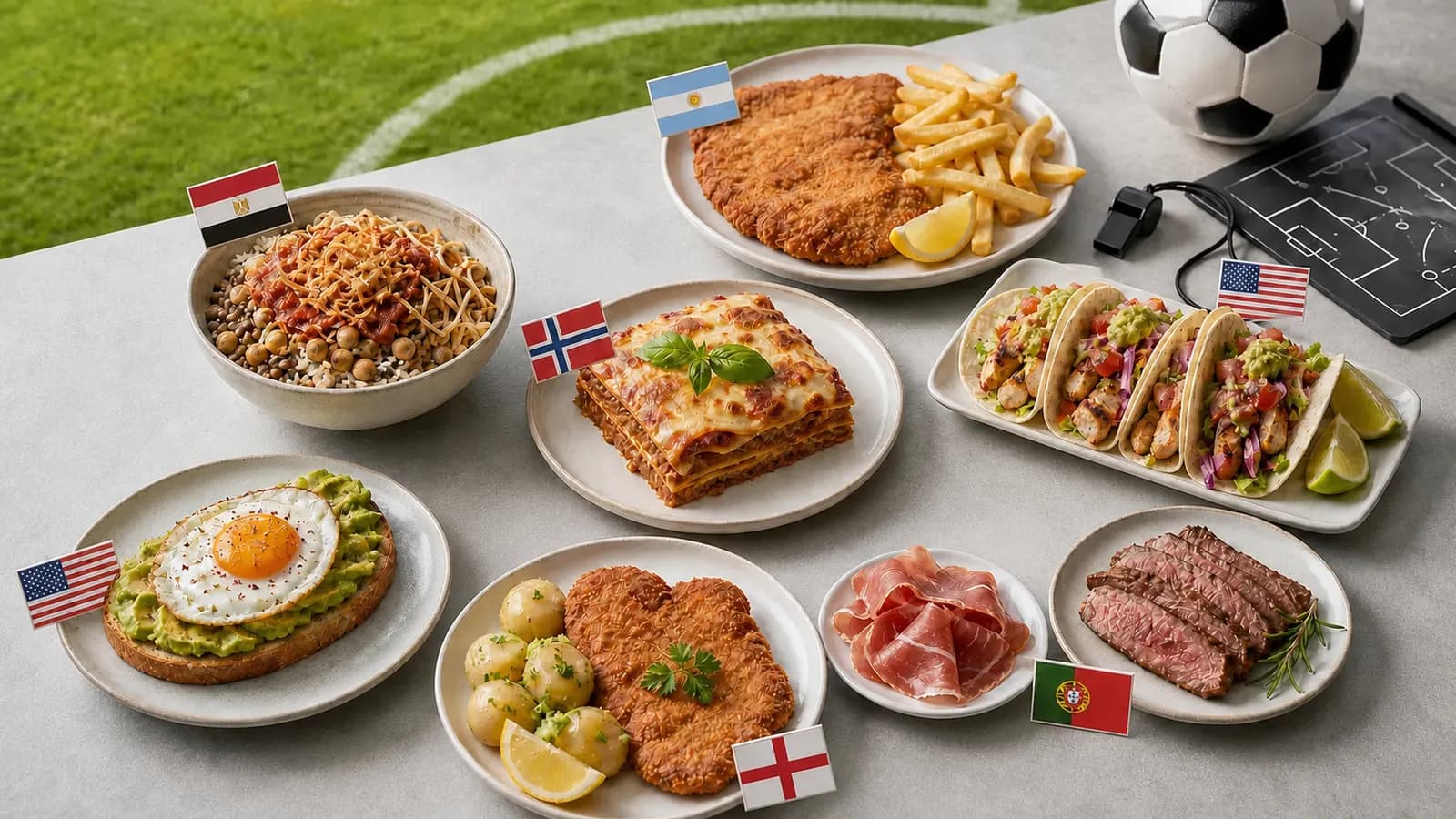
TL;DR. Public favorite-food reporting for footballers is uneven. The strongest claims usually come from direct interviews, named chefs, named teammates, or clearly attributed team-catering reports. As of June 22, 2026, among famous players featured in live 2026 World Cup coverage, this article found usable public food trails for Lionel Messi's milanesa napolitana, Cristiano Ronaldo's chef-reported Iberico ham and dry-aged wagyu favorites, Erling Haaland's family-lasagne and organ-meat diet lore, Harry Kane's Bavarian schnitzel and pretzel bread, Christian Pulisic's avocado toast and tacos, Mohamed Salah's often-listed koshari, and Jude Bellingham's reported eggs with baked beans and fish and chips.123456789101112
The key editorial rule: this is not a leaked World Cup meal plan. It is a researched list of public favorite or go-to food claims, paired with realistic nutrition estimates for a representative serving. Exact calories and macros change with portion size, recipe, cooking oil, brand, and restaurant preparation.
Quick macro table
| Player | World Cup nation | Reported favorite or go-to food | Representative serving | Calories | Protein | Carbs | Fat |
|---|---|---|---|---|---|---|---|
| Lionel Messi | Argentina | Milanesa napolitana with fries | Breaded beef cutlet, tomato sauce, cheese, ham, fries | 1,050 | 56g | 95g | 49g |
| Cristiano Ronaldo | Portugal | Iberico ham | 2 oz / 56g serving | 200 | 16g | 0g | 15g |
| Cristiano Ronaldo | Portugal | Dry-aged wagyu steak | 6 oz cooked steak | 650 | 42g | 0g | 52g |
| Erling Haaland | Norway | Lasagne | Large 450g training-day portion | 850 | 50g | 75g | 38g |
| Harry Kane | England | Schnitzel with potatoes | Breaded cutlet plus modest potato side | 760 | 48g | 65g | 34g |
| Christian Pulisic | United States | Avocado toast | 2 slices toast, avocado, egg | 430 | 17g | 43g | 22g |
| Christian Pulisic | United States | Chicken tacos | 3 tacos with chicken, salsa, avocado | 620 | 38g | 70g | 22g |
| Mohamed Salah | Egypt | Koshari | Large bowl with rice, pasta, lentils, chickpeas, tomato sauce, onions | 800 | 24g | 130g | 20g |
| Jude Bellingham | England | Eggs and baked beans on toast | 2 eggs, beans, 2 slices toast | 560 | 31g | 60g | 20g |
| Jude Bellingham | England | Fish and chips | Pub-size fried fish and chips | 950 | 42g | 95g | 45g |
These numbers are rounded estimates built from USDA FoodData Central entries and ingredient-level modeling.13 They are useful for comparison, not for auditing a professional player's private intake.
Nutrition estimate method
For simple foods, the estimate uses a straightforward serving: 2 oz Iberico-style cured ham, 6 oz cooked wagyu-style steak, or 2 eggs with beans and toast. For composite foods, the estimate models a realistic plate from common components:
| Food | Main assumptions behind the estimate |
|---|---|
| Milanesa napolitana with fries | Breaded fried beef cutlet, tomato sauce, ham, melted cheese, and a restaurant-size fry side |
| Lasagne | Large 450g portion of richer beef-and-cheese lasagne rather than a small packaged square |
| Schnitzel with potatoes | Breaded fried cutlet plus a moderate boiled or roasted potato side |
| Avocado toast | 2 slices toast, about 75g avocado, 1 egg, and light seasoning |
| Chicken tacos | 3 tortillas, chicken, salsa/vegetables, avocado, and a modest amount of cheese or oil |
| Koshari | Large bowl with rice, pasta, lentils, chickpeas, tomato sauce, crispy onions, and oil |
| Fish and chips | Pub-size fried fish fillet and chips, not a small frozen portion |
The purpose is comparability. If the dish is baked instead of fried, smaller, made with leaner meat, or served without fries, the calories and fat can drop sharply.
How we chose the players
As of this article's June 22, 2026 update, the 2026 World Cup is being played from June 11 to July 19 across the United States, Mexico, and Canada, with 48 teams and a wider field than past tournaments.14 That produces a big field of famous players, but not every famous player has a food claim strong enough to publish responsibly.
This article favors players where at least one food claim is visible in public reporting:
| Player | Why included | Source strength |
|---|---|---|
| Lionel Messi | Current 2026 World Cup reporting plus a Messi-family-linked restaurant dish built around his childhood favorite meal | Medium |
| Cristiano Ronaldo | Current 2026 World Cup reporting plus detailed former-chef reporting through tabloids | Medium |
| Erling Haaland | Current Norway World Cup food reporting plus diet documentary and public lasagne lore | Medium |
| Harry Kane | Current England World Cup context plus Bayern teammate and local-food reporting | Medium-high |
| Christian Pulisic | Current USMNT World Cup reporting plus a direct GQ diet interview | High |
| Mohamed Salah | Current Egypt World Cup reporting plus a public biographical koshari favorite-food claim | Low |
| Jude Bellingham | Current England World Cup reporting plus tabloid summaries of prior interview/video material | Medium-low |
Some obvious names are missing for a reason. Kylian Mbappe, Lamine Yamal, Vinicius Junior, Neymar, Son Heung-min, and Alphonso Davies are enormous world football figures, but the public food trail for a specific favorite dish is thinner, less direct, or more social-video-driven. A sports desk should not fill those gaps with internet folklore just to round out a list.
Lionel Messi: milanesa napolitana
Messi is very much a 2026 World Cup story. The Guardian reported on June 22, 2026, that he scored against Austria in Dallas to become the leading scorer in men's World Cup history.1
The food story is milanesa napolitana. Axios Miami reported on the "MilaMessi" at Amalfi Llama in Aventura, a dish described as inspired by Messi's favorite meal growing up in Argentina. Axios also reported that the restaurant counts the Messi family among its investors and that the dish is an homage to a recipe associated with Messi's mother, Celia Cuccittini.2
Representative serving: breaded beef cutlet, tomato sauce, ham, melted cheese, and fries.
Estimated macros: about 1,050 calories, 56g protein, 95g carbs, and 49g fat.
That is a big meal. The protein is solid, but the calories climb because breading, frying oil, cheese, ham, and fries all stack fat and carbohydrate into the same plate. For a footballer after a match or on a high-output day, that can fit. For a normal reader, it is a meal to portion deliberately.
Cristiano Ronaldo: Iberico ham and dry-aged wagyu
Ronaldo's 2026 World Cup role has been debated, but public reporting still places him in Portugal's squad conversation and on the tournament stage. The Guardian, writing during Portugal's group-stage campaign, argued that he remains useful as an experienced squad figure even as questions grow about whether he should still start.3
Ronaldo has one of the more detailed reported food trails in this piece, though the main chef comments come through tabloid reporting. The Sun reported a detailed interview with Kelly Johnson, described as a former senior chef at Manchester United. Johnson said Ronaldo avoided fried foods, processed items, sugar, carbonated drinks, and large amounts of red meat, while eating foods such as coconut-milk porridge, salmon, chicken, boiled rice, sweet potato, tenderstem broccoli, and fruit. She also said United staff imported Iberico ham for Ronaldo and that dry-aged wagyu was one of his favorites.4
Former private chef Giorgio Barone gives a second pattern: avocado, eggs, coffee without sugar, fish or chicken with vegetables, and a light evening meal built around fish or meat fillet with vegetables.5
Representative serving 1: 2 oz / 56g Iberico ham.
Estimated macros: about 200 calories, 16g protein, 0g carbs, and 15g fat.
Representative serving 2: 6 oz cooked dry-aged wagyu steak.
Estimated macros: about 650 calories, 42g protein, 0g carbs, and 52g fat.
The editorial point is scale. Ronaldo's publicly reported everyday pattern is strict and leaner than the premium foods suggest. Iberico ham and wagyu can be favorites without being daily foundations. A small serving of ham is a salty, protein-rich luxury food. Wagyu is protein-rich too, but it is also fat-dense enough to change the calorie math quickly.
Erling Haaland: family lasagne, organ meats, and Norway staples
Haaland is one of the tournament's most recognizable forwards. Guardian World Cup reporting around France's Kylian Mbappe noted Haaland among the major scorers making an early mark at the 2026 tournament, and Norway's own food operation has become a World Cup story.15
The food trail around Haaland is unusually vivid, but it should be treated as diet lore rather than a clean "favorite food" declaration. GQ described the public "lasagne-eating Terminator" image around him, and talkSPORT reported on the documentary Haaland: The Big Decision, in which his eating habits included heart, liver, and his father's lasagne. The same reporting put his intake at an enormous athlete-level calorie number and emphasized local, quality food over processed food.67
At the 2026 World Cup itself, Norway reportedly shipped in familiar foods including Atlantic salmon, white fish, brunost, and oranges for the squad. That is team catering rather than Haaland's personal favorite, but it supports the broader pattern: familiar, digestible, high-quality staples during tournament travel.16
Representative serving: large 450g beef lasagne portion.
Estimated macros: about 850 calories, 50g protein, 75g carbs, and 38g fat.
Lasagne is not automatically "junk food." A large athlete portion can supply protein from beef and cheese, carbohydrate from pasta, and enough fat to make it calorie-dense. The tradeoff is digestion and timing. It makes more sense after training, at dinner, or far from kickoff than as a last pre-match meal.
Harry Kane: schnitzel, pretzel bread, and eggs on toast
Kane opened England's 2026 World Cup with major tournament relevance. England's 4-2 win over Croatia in Dallas put him and Jude Bellingham back near the center of the story, with England trying to play more aggressively under Thomas Tuchel.10
Kane's food record is stronger than most because Bayern coverage gave us named teammate context. The Guardian reported that Jamal Musiala listed Kane's favorite Bayern canteen dishes as schnitzel, pretzels, and pretzel bread with salami, adding that Kane liked pretzel bread best.8 Separate reporting from The Sun described schnitzel as Kane's favorite Bavarian dish and covered a local inn owner delivering schnitzels tied to his goalscoring season.9
England's 2026 World Cup catering also gives a performance-food version of Kane: The Sun reported that former England chef and nutritionist Tim De'Ath said Kane often opts for scrambled eggs on toast where many England players like beans on toast.17
Representative serving: breaded schnitzel with a modest potato side.
Estimated macros: about 760 calories, 48g protein, 65g carbs, and 34g fat.
Schnitzel is a classic example of why "favorite food" and "daily fuel" are not always the same thing. It brings protein and carbs, but frying makes the fat total meaningful. Eggs on toast is the more match-window-friendly Kane-style meal: lighter, protein-forward, familiar, and easier to digest.
Christian Pulisic: avocado toast, tacos, and chocolate
Pulisic is the face of the United States player pool for many fans, and current 2026 reporting has tracked his status during the USMNT's group-stage campaign.11
His best food source is direct. In GQ's Real-Life Diet interview, Pulisic said he missed American food, was a Chipotle ambassador, used avocado toast on game-day mornings, ate a meal three hours before matches, liked tacos as a simple crowd-pleasing dish, avoided sushi, and occasionally enjoyed desserts, especially chocolate.12
Representative serving 1: avocado toast with egg.
Estimated macros: about 430 calories, 17g protein, 43g carbs, and 22g fat.
Representative serving 2: three chicken tacos.
Estimated macros: about 620 calories, 38g protein, 70g carbs, and 22g fat.
Pulisic's public food pattern is not extreme. It reads like a modern footballer's balance: predictable pre-match food, enough carbs to play, enough protein to recover, and room for normal preferences. Avocado toast is higher-fat than many people realize, but with egg and bread it is still a compact breakfast. Tacos can be a strong athlete meal if the protein is lean, the toppings are measured, and the sauce does not quietly become the whole calorie story.
Mohamed Salah: koshari
Salah has also been central to the 2026 tournament. The Guardian's live report from Egypt's 3-1 win over New Zealand described Salah as a key figure in Egypt's historic first World Cup victory.18
The food claim is koshari, listed as Salah's favorite food in public biographical coverage. This is the softest player-food source in the article, so treat it as a reported favorite rather than a direct quote from Salah. Koshari is an Egyptian staple built from rice, pasta, lentils, chickpeas, tomato sauce, crispy onions, and optional vinegar or hot sauce. It is one of the most carbohydrate-forward foods in this list.19
Representative serving: large koshari bowl.
Estimated macros: about 800 calories, 24g protein, 130g carbs, and 20g fat.
For a winger, the macro profile makes intuitive sense as a recovery or heavy-training meal: lots of carbohydrate, moderate plant protein, and enough fat from fried onions or oil to lift calories. It is not a low-carb dish. It is also not empty calories. Lentils and chickpeas bring protein and fiber, while the rice and pasta do the glycogen-refill work.
Jude Bellingham: eggs and baked beans, plus fish and chips
Bellingham's 2026 World Cup relevance needs little explanation after England's opening win. The Guardian reported that his second-half goal helped England pull away from Croatia in Dallas.10
Food-wise, his public trail is a mix of reported diet structure and comfort-food preferences. The Sun summarized Bellingham's diet as high-carbohydrate and lean-protein, with Greek yogurt, oats, chia seeds, grilled meat, vegetables, and tomato toast appearing in reported weekly menus. The same piece says Bellingham has described eggs and baked beans as one of his favorite dishes, has a soft spot for apple crumble, and named fish and chips as his favorite English meal in a Borussia Dortmund team-chef video. Because that article is summarizing prior interview/video material rather than embedding the original full source, this is a lower-strength food claim than Pulisic's direct GQ interview or Kane's named-teammate Guardian reporting.20
Representative serving 1: two eggs, baked beans, and two slices of toast.
Estimated macros: about 560 calories, 31g protein, 60g carbs, and 20g fat.
Representative serving 2: fried fish and chips.
Estimated macros: about 950 calories, 42g protein, 95g carbs, and 45g fat.
Eggs, beans, and toast is the cleaner everyday athlete-food option. It is familiar, protein-rich, carb-supported, and easy to scale. Fish and chips is a different story: still protein and carbs, but with much more frying fat. That does not make it forbidden. It makes it a planned food, not an invisible snack.
What the foods tell us about football nutrition
The celebrity angle is fun, but the sport explains the macro pattern. A classic review in Sports Medicine notes that elite soccer players cover roughly 10 km during a 90-minute match at high average intensity while adding repeated explosive actions such as sprinting, jumping, tackling, turning, and kicking.21
That is why so many of these foods include carbohydrate:
- Messi's milanesa plate brings breading and potatoes.
- Haaland's lasagne brings pasta.
- Kane's schnitzel meal can pair protein with potatoes or bread.
- Pulisic's avocado toast and tacos bring bread or tortillas.
- Salah's koshari is built almost entirely around rice, pasta, lentils, and chickpeas.
- Bellingham's eggs and beans work because toast and beans supply carbs alongside protein.
Protein is the other constant, but it rarely appears alone. Footballers need to repeat high-intensity efforts, recover between matches, and stay available through crowded schedules. In public athlete-food stories, the best meals usually combine:
- A clear protein source
- A visible carbohydrate source
- Enough fat for calories and satisfaction
- Familiar foods that reduce digestion surprises
- Small room for pleasure, because tournament life is long
What regular readers should copy
Do not copy the portion sizes first. Copy the structure.
Use these ideas instead:
- Put protein on the plate.
- Choose carbs that match your activity, not your favorite player's workload.
- Watch frying oil, cheese, fatty meat, nuts, avocado, and sauces because they raise calories quickly.
- Keep favorite foods in deliberate portions rather than treating them as off-plan.
- Use meals you already like, then adjust portions until calories and macros match your goal.
For example, a regular person does not need a 1,050-calorie milanesa plate because Messi likes milanesa. But a smaller baked milanesa with salad and potatoes could be a satisfying dinner. You do not need Haaland's giant lasagne portion, but a smaller lasagne with lean beef and extra vegetables can fit. You do not need Ronaldo's wagyu, but understanding why a small steak differs from a fatty steak is useful.
That is the practical value of celebrity food research: not imitation, but translation.
Frequently asked questions
Are these players' exact World Cup meals?
No. These are public favorite-food or go-to-food claims paired with representative nutrition estimates. Tournament menus are private, change by match timing, and are managed by chefs, nutritionists, and team staff.
Are the calories exact?
No. They are rounded estimates from USDA FoodData Central and common prepared-food references. A restaurant milanesa, homemade milanesa, or baked milanesa can all land in different places. The same is true for lasagne, tacos, koshari, and fish and chips.
Why are some famous 2026 World Cup players missing?
Because the food sourcing was not strong enough. This article intentionally leaves out players when the public record does not support a specific favorite food. A shorter list with cleaner sourcing is better than a longer list padded with unsourced claims.
Which food is best for performance?
Context matters. Before a match, the lighter and more digestible options usually make more sense: eggs on toast, avocado toast, chicken tacos, rice, pasta, or a measured bowl of koshari. After a match or on a heavy training day, bigger meals like lasagne, milanesa, or fish and chips are easier to fit.
Which food is easiest to adapt for weight loss?
Eggs and baked beans on toast, avocado toast, tacos, and koshari are easiest to scale because portions are visible. Fried foods and fatty steaks can still fit, but they require more careful portions because fat is calorie-dense.
References
Footnotes
-
The Guardian. "Lionel Messi breaks men's World Cup record and becomes all-time leading scorer." June 22, 2026. Source ↩ ↩2
-
Axios Miami. "My Argentinian mom tried MilaMessi - Miami's homage to Messi's favorite meal." August 1, 2024. Source ↩ ↩2
-
The Guardian. "Cristiano Ronaldo risks ruining his legacy if he continues to stymie Portugal by starting." June 22, 2026. Source ↩ ↩2
-
The Scottish Sun. "How to eat like Cristiano Ronaldo: Man Utd legend's old chef reveals six favourite meals that keep him ripped aged 41." May 5, 2026. Reporting attributed to former Manchester United chef Kelly Johnson. Source ↩ ↩2
-
The Scottish Sun. "Cristiano Ronaldo's ex-chef reveals secrets to his ripped body at 41 and common drink he avoids - 'it is against nature'." April 23, 2026. Reporting attributed to former private chef Giorgio Barone and his comments to Covers.com. Source ↩ ↩2
-
GQ. "How Erling Haaland Became the Most Terrifying Young Striker in the World." January 17, 2023. Source ↩ ↩2
-
talkSPORT. "Premier League record breaker Erling Haaland has incredible diet that left The Rock stunned and defenders in bits." October 2022, updated September 2024. Reporting on Haaland: The Big Decision. Source ↩ ↩2
-
The Guardian. "'One of our own': how and why Germany has taken to Harry Kane." June 15, 2024. Source ↩ ↩2
-
The Sun. "Harry Kane ends season with 61 SCHNITZELS in bizarre goalscoring reward as England ace declares treat his favourite food." May 26, 2026. Source ↩ ↩2
-
The Guardian. "'People in the pubs will like this': Tuchel keen for England to entertain at World Cup." June 18, 2026. Source ↩ ↩2 ↩3
-
New York Post. "Mauricio Pochettino has plethora of USMNT lineup options for meaningless World Cup game." June 22, 2026. Reporting on the USMNT and Christian Pulisic's injury status. Source ↩ ↩2
-
GQ. "The Real-Life Diet of Christian Pulisic, Potential Savior of American Soccer." December 10, 2019. Source ↩ ↩2
-
U.S. Department of Agriculture, Agricultural Research Service. FoodData Central. Nutrition database used as the baseline for rounded calorie and macronutrient estimates. Source ↩
-
FIFA. FIFA World Cup 26 tournament information and match schedule. Source ↩
-
The Guardian. "Kylian Mbappe hungry for Golden Boot battle with Messi as he sings Les Bleus." June 21, 2026. Source ↩
-
The Sun. "Erling Haaland's Norway 'ship over 400kg of FISH and CHEESE to World Cup' as Scandinavian stars snub American grub." June 2026. Source ↩
-
The Sun. "England to be powered by beans on toast at World Cup base as stars ditch posh food for home comforts in search for glory." June 3, 2026. Source ↩
-
The Guardian. "New Zealand 1-3 Egypt: World Cup 2026 - as it happened." June 22, 2026. Source ↩
-
Mohamed Salah public biographical coverage, including its personal-life section citing favorite-food reporting, and koshari dish background. This is used as a low-strength food source because the underlying original interview/article was not recoverable during this reference check. Salah, Koshari ↩
-
The Sun. "Inside Jude Bellingham's diet and fitness regime that could score England a Euro 2024 win." June 20, 2024. Source ↩
-
Stolen T, Chamari K, Castagna C, Wisloff U. "Physiology of soccer: an update." Sports Medicine 35(6):501-536. 2005. PubMed ↩